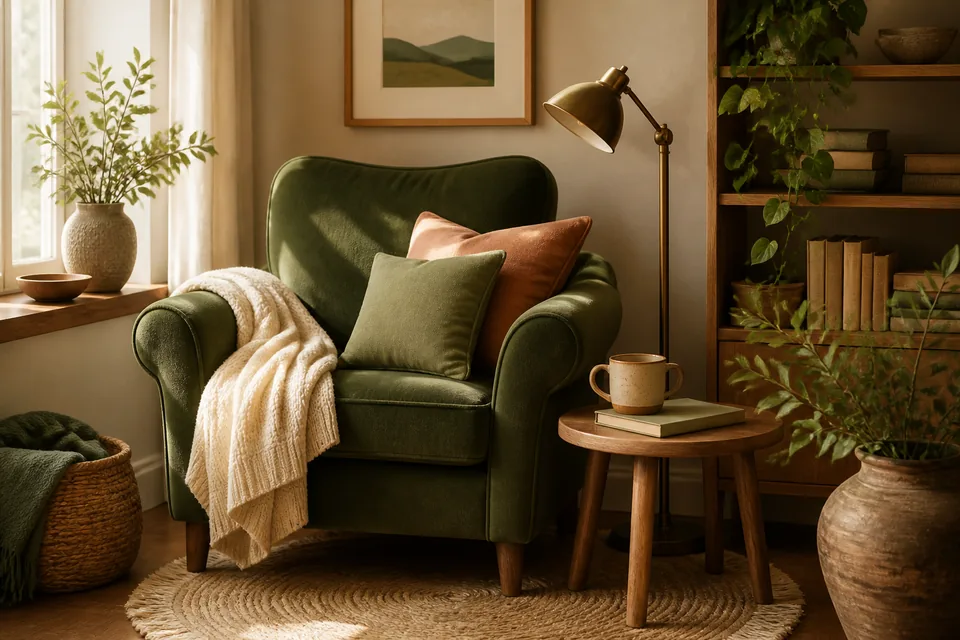
"Cozy" gets used as a decorating style — warm neutrals, layered textures, a certain kind of Pinterest board — but it started as a description of how a space feels, not how it looks. That distinction matters, because a room can check every visual box of "cozy decor" and still feel cold, and a nearly empty room can feel genuinely cozy if a few sensory details are right. Here's what actually separates the two.
Cozy is a lighting decision before it's a decorating one
The single biggest lever isn't furniture or textiles — it's light temperature and light height. A room lit entirely by one overhead fixture, even a warm-toned one, reads as functional rather than cozy, because overhead light is flat and shadowless in a way that feels closer to an office than a living room. Two or three lower, warmer light sources — a table lamp, a floor lamp, even string lights — do more for "cozy" than any amount of throw pillows, because they create the pools of light and shadow that make a room feel like it has depth and a sense of evening.
It needs at least one texture you'd want to touch
Visually cozy and physically cozy aren't automatically the same thing. A room can look warm in photos and still feel sparse in person if nothing in it invites touch — a smooth, hard-surfaced room photographs fine but doesn't feel inviting to sit in. At least one texture that's genuinely soft to the touch — a knit throw, a plush rug underfoot, a nubby chenille pillow — does more work than several textures that only look soft.
Scent and sound, underrated
These rarely make it into decorating advice because they don't photograph, but they're part of why some rooms feel cozy in person in a way photos don't capture. A subtle, consistent scent — not overpowering, just present — and the absence of harsh echo (soft furnishings absorb sound in a way bare walls and hard floors don't) both contribute to a room feeling settled rather than sparse, even when neither shows up in a photo.
You don't need much of any of it
This is the part that gets lost in "cozy home" content, which often implies you need a fully furnished, fully styled room to get there. In practice, the sensory shifts that matter most — better lighting, one genuinely soft texture, a bit of visual layering — are achievable with two or three additions to a room you already have, not a full redecorating project. That's the actual premise of this site: small, specific, affordable changes, chosen for what they do to how a room feels, not just how it photographs.
For where to start, our room-by-room guides cover the living room, the entryway, the kitchen, the bedroom, and the bathroom — each with one or two specific, low-effort changes rather than a full room plan.