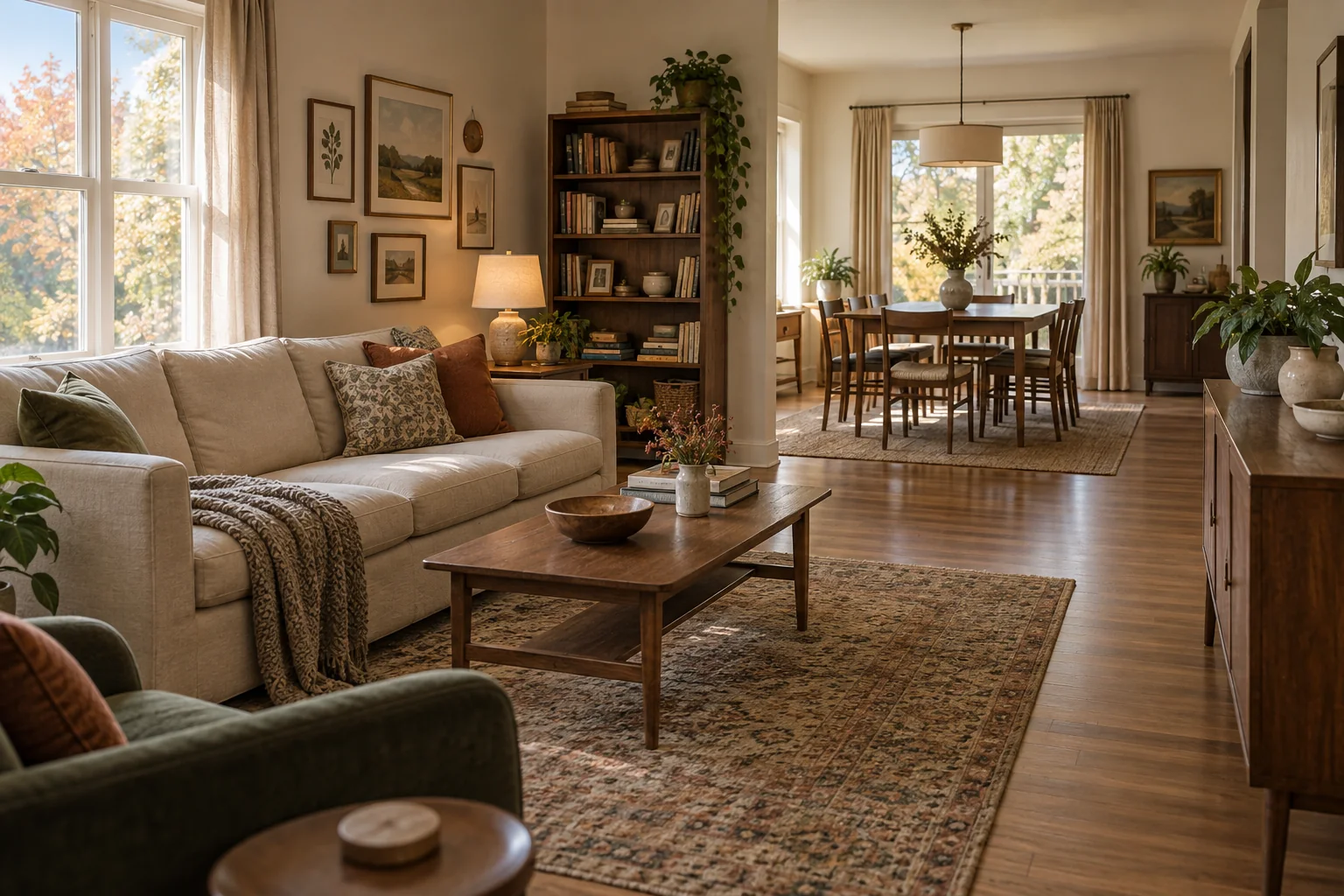
A home can hold family photographs, travel finds, inherited furniture, children’s art, favorite books, and the evidence of ordinary life without feeling visually crowded. The difference is rarely the number of meaningful things you own. It is whether the room gives those things a clear place to belong.
A collected room tells a few readable stories. A cluttered room asks the eye to process every object at once. The answer is not to erase your personality or replace it with matching containers. It is to make deliberate groups, leave quiet space around them, and keep the supplies of life close but less visible.
1. Decide what the room needs to support
Before styling a shelf or buying storage, name the room’s two or three main jobs. A living room may need to support conversation, television, reading, play, and company—but those needs do not all deserve equal visual space every hour of the day.
Walk through a normal evening. Notice what gets carried in, where it lands, what must be moved before someone can sit down, and which surfaces need to remain useful. This separates meaningful display from supplies that simply need a convenient home.
Try this first: clear one frequently used surface and return only what supports the room or tells a story you genuinely want to see.
2. Choose one visual anchor
Every display becomes easier to read when one object leads it. On a wall, that might be the largest framed piece. On a bookcase, it could be a ceramic bowl, a stack of oversized books, or a photograph with enough scale to be seen from across the room.
The anchor does not need to be expensive, symmetrical, or professionally framed. It only needs enough presence to keep the smaller objects from competing equally. Begin with the anchor, then add supporting pieces one at a time.
A room may have more than one display, but each sightline does not need a separate focal point. From the main entrance, decide where you want the eye to settle first.
3. Group small things into one story
Five objects spread across five surfaces read as five separate interruptions. The same objects gathered on one shelf can read as a single story.
Group by relationship rather than by perfect color matching: photographs from one branch of the family, vessels picked up on trips, books about a shared interest, or small objects made by the same person. Vary height and shape, but keep enough similarity that the group feels connected.
Trays can help, but they are not required. A stack of books, a shallow bowl, or the boundary of one shelf can create the same visual container. Stop before every inch inside that boundary is filled.
4. Use vertical space—and set a stopping line
When every meaningful object lands on a table or dresser, daily life loses its working space. Move selected pieces upward to a wall, picture ledge, bookcase, mantel, or the upper portion of an existing cabinet.
Then choose a stopping line. It might be the top two shelves of a bookcase, one section of a gallery wall, or one short ledge. A boundary keeps a collection from expanding across the whole room simply because another object fits.
Use appropriate hardware, observe weight limits, keep breakable objects away from edges, and follow the instructions for the wall and surface you have.
5. Repeat one material or color
Collected rooms often contain objects from different years and styles. Repeating one material or color helps those differences feel intentional without making everything match.
Warm wood can appear in a frame, a small table, and a box. A muted rust may repeat in a book spine, textile, and artwork. Black can connect frames of different sizes. The repetition should be quiet enough that the personal objects remain the point.
This principle works in traditional, modern, farmhouse, cottage, and mixed homes because it creates a visual thread rather than imposing a theme.
6. Leave quiet space around each group
Empty space is not unfinished space. It is what allows the objects you kept to be noticed.
After arranging a shelf, remove one item and step across the room. If the group becomes easier to understand, leave it out. Keep part of each shelf visible, preserve a clear landing area on working surfaces, and avoid filling every wall at the same visual height.
If a room still feels busy, photograph it from the doorway. The smaller image makes repeated colors, crowded edges, and competing focal points easier to see.
7. Display meaning; hide supplies
There is no moral difference between a beautiful object and a practical one, but they ask different things of a room. Display the pieces that carry memory, beauty, or a story. Give charging cords, backup candles, instruction manuals, remotes, and hobby supplies an accessible drawer, box, cabinet, or basket.
Storage should shorten the reset. Put it near the activity it serves, label it when several people use it, and size it to the actual category. An oversized container often becomes permission to keep more than the routine needs.
For another practical approach to everyday drop zones, use the small-entryway guide.
8. Rotate instead of accumulating
Not everything meaningful must be visible at the same time. A rotation lets photographs, children’s art, seasonal objects, and small collections receive attention without becoming permanent layers.
Choose one box or protected shelf for the off-display group. Label it by person, season, room, or story. When a new object enters the display, move another one into the rotation instead of extending the display’s boundary.
This is especially useful for objects that are meaningful together but visually noisy when separated around the house.
An optional home for one small collection
Use an existing shelf, frame, or shallow tray first. If small three-dimensional keepsakes need a defined display, a shadow box is one option—not a reason to buy more objects to fill it.
Americanflat Front-Opening Shadow Box, Black, 8 by 10 Inches
Best for: a few shallow keepsakes that belong to one story, such as a medal and a photograph. The listing describes an engineered-wood frame with a glass front, a hinged opening, magnetic closure, and included push pins.
Measure first: the listed interior depth is 1.4 inches, while the exterior depth is 2.3 inches. Check the thickest object and leave room to close the front. The frame can stand on a tabletop or hang vertically or horizontally using the supplied hardware; follow the mounting instructions for your wall.
Limits: shatter-resistant glass is not unbreakable, and push pins may not suit fragile or irreplaceable material. We have not hands-on tested this frame, and we are not recommending it as archival storage. Keep small mounting parts away from children.
No-buy alternative: rotate one sturdy keepsake on an existing shelf and store the remaining pieces safely. Skip the frame if you already have a useful display or your objects are too deep.
Check current details on Amazon →9. Recheck the room in real life
A display that looks balanced in daylight may feel busy once lamps, television screens, school bags, or dinner dishes enter the room. Use the space for several days before deciding it is finished.
Sit in the usual seats. Walk the common routes. Open cabinet doors. Dust the display. Put daily items away. If keeping the arrangement neat requires a careful ritual, it probably needs fewer pieces or a simpler boundary.
The cozy fall living-room reset can help if furniture flow, lighting, or everyday storage—not the displays themselves—is creating the pressure.
A 30-minute collected-not-cluttered reset
- Choose one surface or one wall section—not the whole room.
- Remove everything and wipe the area.
- Return one object large enough to serve as the anchor.
- Add two or three related pieces.
- Repeat one color or material already in the room.
- Move practical supplies into nearby closed storage.
- Place the remaining meaningful pieces in a labeled rotation box.
- Photograph the result from the main entrance.
- Live with it for three days before adding anything.
If the goal is a calmer home rather than a styled shelf, continue with what “cozy” actually means in a room and how to welcome early fall without buying more décor.
Collected-not-cluttered FAQ
How do I display sentimental items without making the room look cluttered?
Choose one bounded display area, lead with one larger anchor, and group a few related objects there. Store the rest as a labeled rotation so every meaningful piece does not have to compete at once.
How many objects should be on a shelf?
There is no universal number. The shelf should retain visible open space, the objects should be easy to dust and return, and the group should still read clearly from across the room. Remove one piece and compare before deciding.
Can a maximalist home still feel uncluttered?
Yes. Maximalism can be abundant and still have clear groupings, repeated colors, usable surfaces, and protected paths. Clutter is more about visual competition and friction than a single acceptable object count.
What should I do with items that do not fit the display?
Place meaningful pieces in a protected, labeled rotation; relocate practical supplies near their use; donate items you no longer want; and give uncertain objects a temporary box with a review date.
Where to begin tonight
Choose the surface you use most. Clear it, return one meaningful group, and leave enough room for tomorrow’s ordinary life. That single boundary will teach you more than trying to style the entire house at once.
Why this topic now: Recent home research points toward personal, layered rooms alongside a continued need for comfort and practical organization. See the 2026 U.S. Houzz Fall Design Trends Report, IKEA Life at Home Report 2026, and Etsy’s Spring/Summer 2026 Seller Trend Report. Reviewed September 15, 2026.
Image note: The lead image is an original AI-generated editorial illustration created for The Cozy Everyday. It is not a photograph of a real home or a retailer product image.