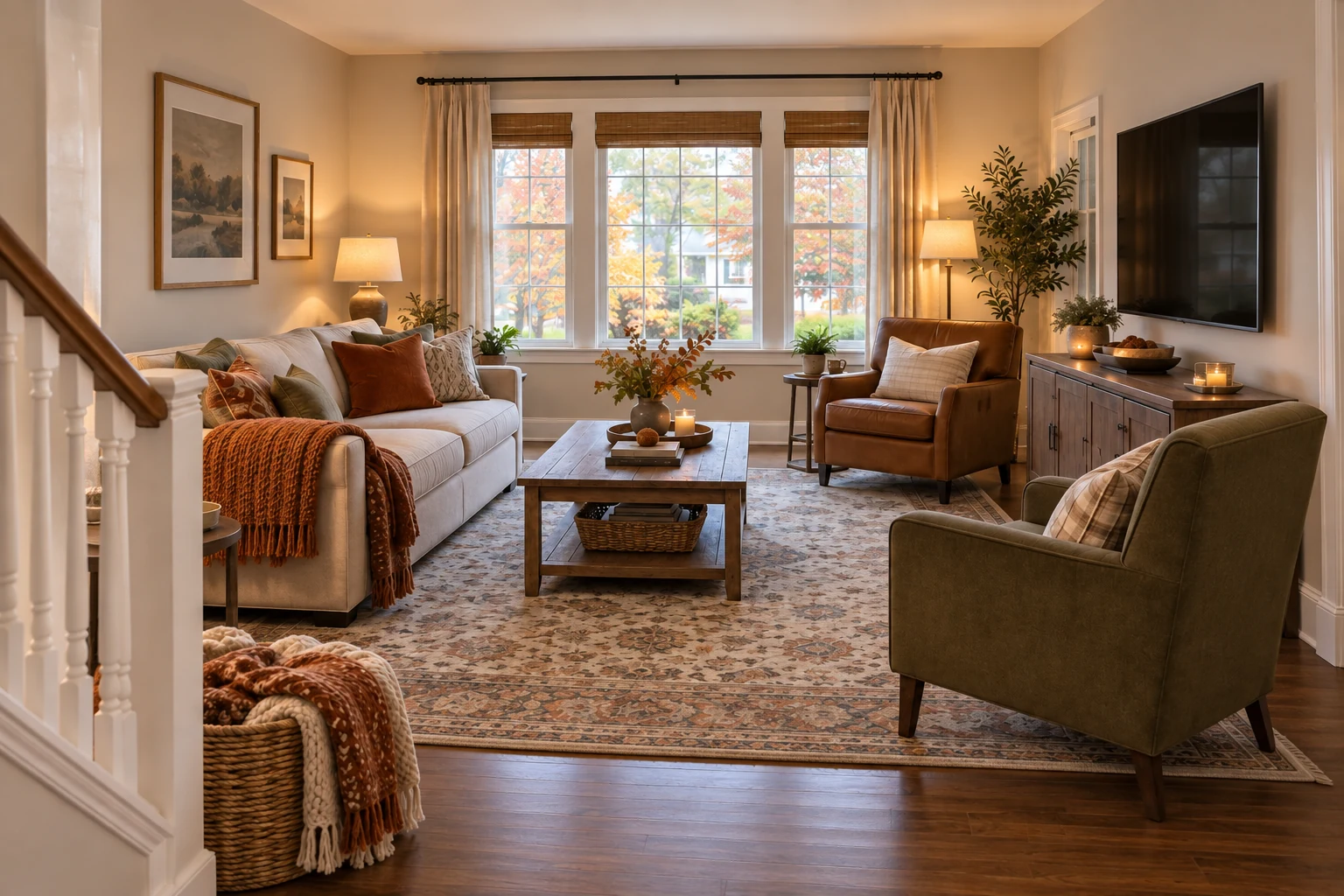
A fall living room does not have to follow one floor plan, decorating style, or kind of household. It might be a family room where everyone lands after dinner, a formal room that needs to feel less stiff, an open living-and-dining space, or a compact room carrying several jobs at once.
The useful question is the same in every case: what would make people want to settle here—and what is currently getting in the way?
Often, the answer is not more fall décor. It is a seating group that makes sense, light where people need it, a place for the things the room actually uses, and enough open space that the room does not feel like work. These ideas scale up or down. Use the version that suits your home and leave the rest.
1. Begin with the life already happening in the room
Before moving furniture, name the two or three things the room supports most often. That might be television, conversation, reading, children playing, pets stretching out, company gathering, or someone working with a laptop for part of the day.
A room can serve more than one purpose, but every purpose does not need its own piece of furniture. The same chair can face the sofa for conversation and turn slightly toward a lamp for reading. A console can hold media equipment, closed storage, and a clear landing area without becoming three separate stations.
Walk through one normal evening in your mind. Where does everyone sit? What gets carried into the room? Which object is always moved? That repeated friction is a better starting point than a picture of somebody else’s house.
Try this first: clear the main table and one seat. Use the room for an hour. The first item you go looking for is useful evidence; the things you do not miss may not need to return.
2. Create one clear gathering zone
The gathering zone is the main group of seats people naturally use together. In a compact room, it may be a sofa and one chair. In an average family room, it could be a sofa with two chairs angled toward it. In a larger room, several seats may form one generous group, with a quieter reading or game area elsewhere.
Avoid letting the size of the room decide how much furniture it must contain. A larger room does not need every wall filled. A smaller room does not automatically need miniature furniture. The pieces need to fit the activities, seat the people who regularly use them, and leave comfortable routes around the group.
Try turning one chair toward the other seats rather than lining everything against the walls. If television is part of the room, keep a comfortable view of it without making every seat stand at attention. Conversation, reading, and resting should still feel possible.
Use a rug you already own to help the seats read as one group. It does not have to follow a perfect design rule. It simply needs to visually connect the pieces without becoming a curled or slippery obstacle.
3. Protect the routes people use
Cozy should never mean squeezing between furniture. Walk from each entrance to the main seats, windows, storage, and adjoining rooms. Pull chairs out as people actually use them and open any nearby door or cabinet.
In an open-plan home, pay special attention to the route between the living and dining areas. The two spaces can share color and materials while keeping their movement paths distinct. In a larger room, people should be able to join the gathering without circling several pieces. In a busier family room, the route may also need to work when bags, toys, or pet supplies briefly enter the picture.
Do not rely on one universal clearance measurement. Furniture depth, door swings, mobility needs, and the number of people using the home all matter. Painter’s tape or flattened boxes can test a proposed table or chair footprint before anything new arrives.
4. Layer the light across the room
Fall evenings reveal what afternoon sun has been hiding. One ceiling fixture may make the room bright while leaving faces flat, a reading chair dim, and the corners disconnected.
Turn on the room after sunset and sit in the usual places. Check whether there is useful light for reading, conversation, games, or finding a remote. Move an existing table or floor lamp before buying another one. A compatible warmer bulb may improve the atmosphere, but the fixture still has to put enough light where the activity happens.
Rooms with more than one seating area often benefit from more than one low source of light. Repeating a similar warm tone across two or three lamps can connect a larger space without making it feel like a showroom. Keep cords away from walking paths and follow each fixture’s instructions.
For a closer look at the role of light and texture, continue with what “cozy” actually means in a room.
5. Put texture where comfort happens
Texture earns its place when somebody uses it. Put one throw where a person can reach it from the sofa. Add a supportive pillow where a seat needs it. Let the rug soften the area where feet land.
You do not need matching blankets on every chair or pillows stacked beyond the usable depth of the sofa. In a larger room, repeat a material rather than an entire product: the same warm wood tone on two tables, or a similar woven texture in two seating areas. In a compact room, keep the layers fewer so the furniture remains easy to use.
Contrast usually adds more warmth than quantity. Pair a smoother cotton or linen with one nubby knit or woven material instead of piling on several versions of the same plush texture. If blankets have already multiplied, use the Layered Throw Method to edit what you own.
6. Give every surface some breathing room
A coffee table should be able to hold the evening: drinks, a book, a game, snacks, or the remote. If a permanent arrangement must be dismantled every time people sit down, the styling is making the room less welcoming.
Clear the table and return only what supports the room’s common uses. A tray is helpful when it lets several small items move together. It is not helpful when it becomes another boundary to fill.
Larger rooms often collect extra side tables simply because there is space for them. Keep the ones that give a seat a useful landing place. Smaller rooms may work better with two compact side surfaces and no central table at all. The right answer is the one that supports the household without interrupting movement.
7. Let one fall color move through the room
Choose a color that already belongs with the room: muted rust, deep olive, warm gold, tobacco brown, burgundy, or cream. Repeat it in two or three useful places rather than introducing a separate fall theme.
A rust throw can speak to a branch arrangement across the room. Olive pillows can connect the living area with chairs near the dining table. Warm wood and amber lamplight may already provide most of the seasonal feeling.
This approach works across farmhouse, traditional, contemporary, cottage, and mixed homes because the room keeps its own identity. Fall changes the mood; it does not replace the house.
For more seasonal changes without another storage bin, use our early-fall guide to working with what you already own.
8. Give everyday clutter a short trip home
Blankets, games, charging cables, toys, magazines, and remotes are not proof that a room has failed. They are signs of how the room is used. The goal is to give the common items a home close enough that resetting the room does not become a separate project.
A basket may work for two frequently used blankets. A drawer or closed cabinet may work better for electronics and games. A lidded container can hide visual noise, but only if everyone can reach and return what belongs inside.
Choose storage by the object and the routine, not by an empty corner. Measure the intended place, keep vents and doorways clear, and resist buying a large container before deciding what it will hold.
No-buy version: assign one existing drawer, basket, cabinet shelf, or sturdy box to the items that repeatedly stay behind after the evening ends.
If the repeated problem is concentrated near the sofa or television, we also added two measured options to calm a media-area cord cluster and give everyday sofa-side items a nearby home. Each includes the fit limits and a use-what-you-have alternative, so you can decide whether a purchase would actually improve the routine.
9. Test the room with the people who use it
Do not judge the reset only from the doorway. Invite the room back into ordinary life.
Sit in every seat. Carry in drinks. Turn on the television or open a book. Let children play or friends gather if those are normal uses. Walk between the living and dining areas. Put the blankets away. Notice whether everyone can see, hear, reach, and move comfortably.
Write down the first repeated irritation: poor light, a blocked route, nowhere to set a cup, a table that dominates the group, or storage that is too far away. Solve that specific issue before adding anything else.
A 45-minute cozy fall living-room reset
- Photograph the room from each main entrance.
- Name the two or three activities the room supports most.
- Clear the main table and one seat.
- Turn or move one chair to strengthen the gathering zone.
- Walk every route with the furniture in use.
- Test the lamps from the seats after sunset.
- Return one useful throw and one repeated fall color.
- Give the most common loose items a nearby home.
- Live in the room for an evening before making a shopping list.
If you have an open living-and-dining area, use the same color and wood tone to connect the zones while protecting the path between them. If your room is compact, the small-space reading-corner guide and fall ideas for apartments offer more specific variations. Those are supporting branches—not the audience for this main guide.
Cozy fall living-room FAQ
How can I make a living room cozy for fall without buying décor?
Start with the furniture and lighting already in the room. Turn one chair toward the gathering, move a useful lamp closer to a seat, clear the main table, bring out one throw, and repeat one warm color that already belongs in the house.
How do I make a large living room feel cozy?
Create one generous seating group instead of filling every wall. Connect its seats with a rug or repeated material, place useful light around the group, and leave clear routes into and around it. A second quiet zone is useful only when the household will actually use it.
What makes an open-plan living room feel warmer?
Repeat one restrained color, wood tone, or woven texture across the living and dining zones while keeping the path between them open. Separate pools of warm light can help each area feel settled without visually cutting them apart.
How many fall colors should I add?
One color repeated in two or three useful places is often enough. Choose a shade that already works with the room rather than introducing a whole new theme.
Where to begin tonight
Clear the main table and one seat, then turn on the lamps and use the room for an ordinary evening. The first thing that interrupts comfort or movement is the first thing worth fixing.
You do not need to finish a room before fall can feel welcome. You only need to make the room easier to enter, easier to use, and easier to reset when the evening is over.
Image note: The lead image is an original AI-generated editorial illustration created for The Cozy Everyday. It is not a photograph of a real home or a retailer product image.