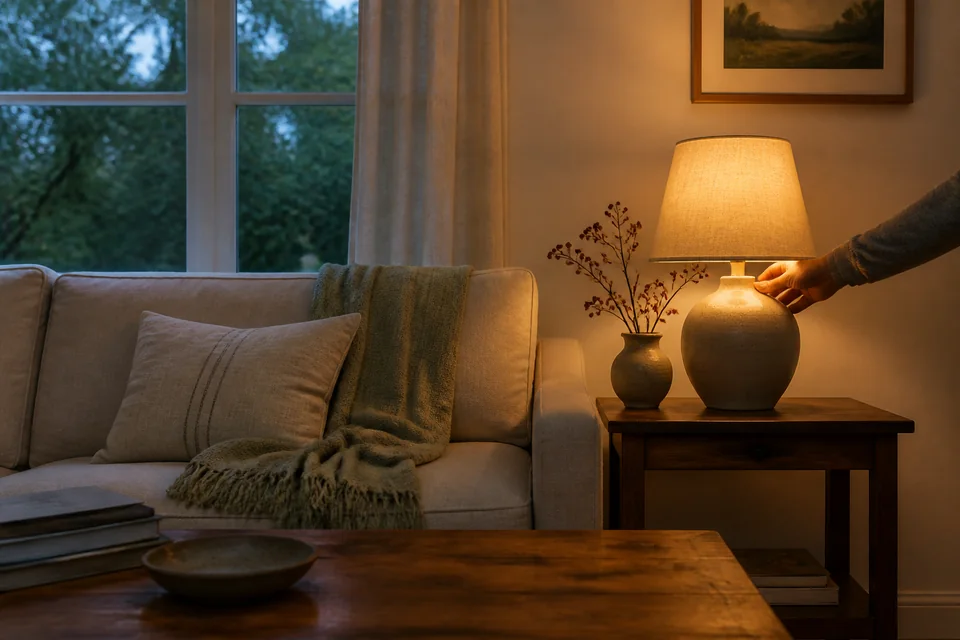
There is a particular kind of restlessness that arrives near the end of summer. The daylight changes. Mornings begin to feel different. Even when the afternoon is still warm, the house starts asking for a softer landing at the end of the day.
That feeling can quickly become a shopping list: new pillows, artificial leaves, signs, pumpkins, baskets, and a storage bin to hold all of it later. But most rooms do not need more objects. They need a small change in atmosphere.
The easiest way to welcome early fall is to work with what the season is already changing—light, temperature, rhythm, and attention.
Begin with what is happening outside the room
Before changing anything, notice when the room stops feeling comfortable. Is the corner beside the sofa dim by dinner? Are mornings cooler while afternoons remain warm? Are you spending more time inside after sunset?
That answer tells you what the room actually needs. It may be a lamp turned on earlier, a throw moved within reach, or a clearer place to set down a warm drink. None of those changes requires a decorative theme.
Choose one moment to improve. “I want the living room to feel welcoming after dinner” is more useful than “I need to decorate for fall.”
Lower the light before adding more things
Overhead lighting is useful when you are cleaning or looking for something. It can feel harsh when the day is winding down. Try turning it off and switching on the lamps you already own. If the room still feels flat, move one lamp closer to where people actually sit instead of buying more decoration.
If a bulb genuinely needs replacing, a warm-toned LED can help. U.S. Department of Energy lighting guidance describes 2700K as a warm, friendly appearance commonly used in homes and libraries, while 3000K remains warm but a little clearer. Buy one bulb first and live with it for a few evenings. A bulb labeled dimmable must also be compatible with the dimmer and fixture you already have.
The goal is not to make the room orange. It is to give evening a softer place to begin.
Philips A19 Warm Glow Dimmable LED Bulb
This single E26-base A19 bulb is listed at 800 lumens and 2700K. Its Warm Glow feature shifts the light warmer as it dims, which can soften an evening lamp without adding another decorative object.
Check before buying: confirm the base, fixture rating, and dimmer compatibility. Lamp placement and shade material can change the result, so start with one bulb rather than replacing a whole room.
Check current details on Amazon →Change one thing you can touch
Cozy is often physical before it is visual. Wash the throw that has been stored away, turn a favorite blanket to the side with the better texture, or move it from a closet to the arm of the sofa. If the weather is still hot, leave it folded nearby rather than piling it on the room.
You can make the same kind of shift in a bedroom with a cotton quilt at the foot of the bed, or in a kitchen with one clean, heavier hand towel. One useful layer is enough.
Bring in one honest piece of the season
The most convincing seasonal detail may already be outside. A few clipped branches from your own yard, grasses from a permitted place, or one inexpensive grocery-store stem can give a room a sense of time without turning it into a display.
Use a plain pitcher, jar, or vase you already own. Keep the arrangement loose and small enough that it does not take over the surface. If bringing plants inside is not practical, set out a bowl of apples you will actually eat.
Clear one surface
A room rarely feels calmer because another object was added to an already crowded table. Choose one visible surface—the coffee table, the top of a small cabinet, or one section of the kitchen counter—and return the things that have drifted there.
Then add back only what supports the moment you chose: perhaps a lamp, a coaster, and the book you are reading. Empty space is not unfinished. It is part of what lets a room breathe.
Let color be a small accent
You do not need a full fall palette. Look for one deeper color already in the house: muted rust, olive, brown, plum, or navy. It might appear in a book cover, a folded towel, a piece of pottery, or the reverse side of a pillow you already own.
Repeat it once, at most twice. The room will feel connected to the season without looking staged for it.
The ten-minute version
- Clear one small surface.
- Turn off the overhead light and switch on one lamp.
- Move one useful throw or quilt within reach.
- Bring in one natural element or set out something seasonal you will use or eat.
- Stop before the room becomes a project.
Early fall does not need its own storage bin. It can be a quieter lamp, a useful layer, and a room that makes it easier to notice the change already happening.
Helpful source: ENERGY STAR light-fixture guidance. Reviewed August 24, 2026.