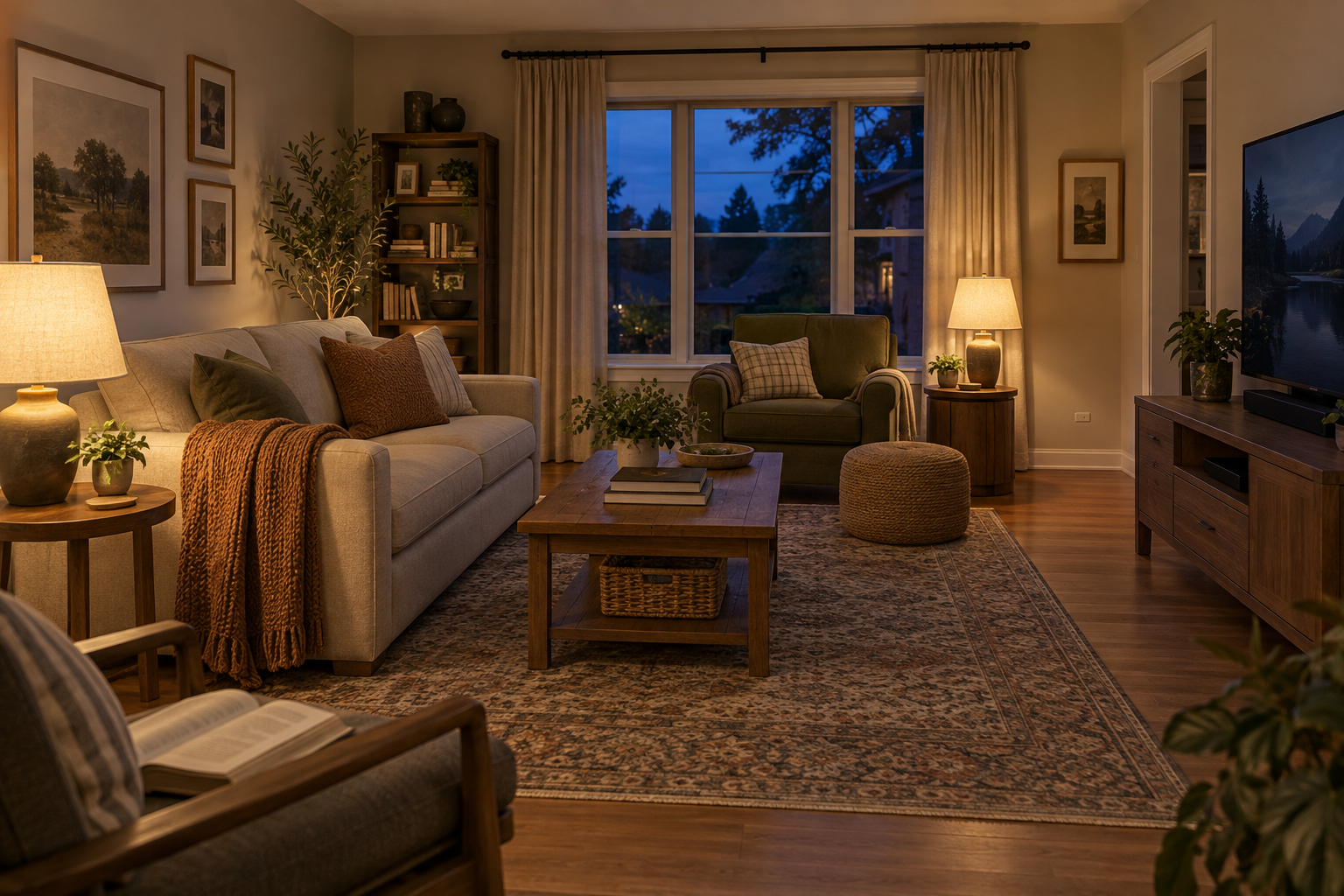
A lamp can make the room look inviting from the doorway and still shine straight into your seated view. The room can seem bright while a book is difficult to see. A pale patch on the television may be a reflected lamp, not a reason to dim every light.
These are different problems. The four checks below help you separate them; they do not identify every possible cause of discomfort. Start with one specific moment that bothers you, not a shopping list or a rule that all overhead lighting must go.
Name the symptom before changing anything
| What you notice | What to distinguish | Start here |
|---|---|---|
| A bright point catches your eye from the seat | The light source itself, rather than its image on a screen. | Isolate the visible source |
| The room looks bright, but your page is difficult to see | Light reaching the task, rather than the room’s overall appearance. | Check the same page |
| A lamp-shaped spot or pale patch sits on the screen | A reflected source, rather than general room brightness. | Trace the reflection |
| You can see the activity, but dislike the light’s color | Color appearance, rather than how much useful light you have. | Separate color from output |
Keep each test small and reversible
Use your normal evening seat, activity, and other lights as the starting arrangement. Keep enough light for everyone to move safely. Change only one source, position, or available setting per trial. Return to the starting arrangement before trying a different variable.
Use ordinary portable-light controls and manufacturer-permitted adjustments only. Before moving a lamp, switch it off, unplug it, and let it cool as its instructions require. Use a stable, suitable surface, keep cords out of walking routes, and maintain the manufacturer’s required clearances. Do not cover a bulb or shade, improvise a diffuser, modify a fixture, or alter wiring.
1. A bright source is in your seated view
Observe: From the normal seat, notice whether the distracting point is an exposed bulb or luminous part of a lamp. Do not stare into it. If you see the light only as an image on the television, use the reflection check instead.
Try one change: Switch that suspected lamp off while leaving the other lights and your seat unchanged, provided the room remains usable. This identifies its contribution; it is not a recommendation to leave the room darker.
Recheck: Resume the same activity. Did that bright point disappear, and is the activity still easy to see? If the bright point disappears and the activity remains easy to see, the source is worth addressing. If the point disappears but reading becomes harder, you have a tradeoff, not a finished solution.
If it did not help: Restore the lamp before checking another source. If it did help but removed useful light, a separate trial can reposition the same portable lamp within its instructions, with its original setting restored. If no suitable position works, record the need for a light that serves the activity without an exposed source in that seat’s view.
2. The room is bright, but the page is not
Observe: Keep the book or handwork in its ordinary position. Is a shadow crossing it, or is the useful light landing elsewhere? Do not judge from a photograph or by how brightly the walls are lit.
Try one change: If an existing task lamp has an intended adjustable head, change only its permitted aim toward the task. Otherwise, try one suitable new position for the portable lamp. Keep its color and brightness controls unchanged; follow the movement precautions above.
Recheck: Use the same page and posture, including the usual hand position. Is the task clearer without a new bright source in your view? Check the result with your hands doing the activity, not just resting on your lap.
If it did not help: Undo the change. In a separate trial, try an existing permitted brightness setting while keeping position and color fixed. If neither trial supplies useful task light, record that missing function instead of adding general room brightness indiscriminately. Our reading-corner guide covers the wider seating and reading setup.
3. A light appears on the television or screen
Observe: Note the patch’s location from the usual viewing seat. Pause the same image for the comparison; leave screen settings unchanged. A reflection is light arriving via the screen, so a lamp outside your direct view can still be involved.
Try one change: Switch off one suspected portable lamp, leaving the other lights in their original state and enough light for the room to remain usable. Do not turn everything off at once: that would hide which source contributed.
Recheck: From the same seat and paused image, did the particular patch disappear? If yes, that lamp contributes to that reflection. Restore it, then make a separate trial of one permitted lamp-position change with its original setting. Check whether the patch moves away from the picture area or becomes less distracting.
If it did not help: Restore the original arrangement before testing another suspected source individually. An unchanged patch means this trial has not identified its source. Do not keep dimming unrelated lamps or compensate by changing the television at the same time. If the source cannot be adjusted within this guide’s limits, keep the observation for a lighting or room-layout professional.
4. You dislike the color, although you can see the activity
Color temperature, usually labeled CCT or Kelvin, describes the light’s color appearance. Lumens describe a source’s light output; watts describe electrical power use. These are different specifications. The amount reaching your page also depends on the arrangement, so a color label alone cannot promise useful task light.
Observe: Ask two separate questions: “Can I see what I am doing?” and “Do I like this warmer or cooler appearance?” If the first answer is no, begin with the task check.
Try one change: If a lamp already provides independent color and brightness controls, change only its color setting. Leave placement, other lights, and the brightness control unchanged. Matching control positions do not guarantee identical output between color settings, so this is a practical preference check, not a measured experiment.
Recheck: From the same seat, look at the same activity and room surfaces. Keep the preferred color only if the task remains clear. A setting you like in the room but cannot use for reading has not solved both needs.
If it did not help: Restore the original setting. If color and brightness change together—or your lamp offers no color choice—you cannot isolate color this way. Record the uncertainty; do not assume dimmer means warmer, or that a warmer bulb will fix a reflection or a dim page. No single color temperature suits every person and activity.
In an open-plan room, keep useful kitchen light on while cooking or cleaning up. Check the sitting area from its usual seats without switching off light another person needs. If adjoining areas share one switch, work within that limit; a cozy scene is not a reason to make an activity harder to see.
Check the second seat, then keep or revert
Before keeping a change, ask another regular user to try their seat and activity. Walk the ordinary route through the room. A clearer television view for one person is not a good result if another loses reading light or a moved lamp introduces a cord across the floor.
A four-line note for the next evening
- Observation
- Which seat, activity, and specific problem?
- One change
- Which source, position, or setting changed?
- Recheck
- Better, unchanged, or worse in the same context? What about the second seat and route?
- Decision
- Keep, revert, or investigate one remaining question.
For example: “Sofa, paused television image, pale patch at right; left lamp switched off; patch gone but chair too dim; restore lamp and try its position separately.” That note is more useful than “buy warmer lighting.”
Repeat a promising arrangement on another ordinary evening before buying anything. If it works, stop there. If it does not, the shopping brief should name a missing function and the fixture’s requirements—not a prescribed number of lamps or a universal brightness target.
Only if your page still needs its own light
Try the existing-lamp checks first. If your ordinary reading position still lacks useful light, a directional clip-on lamp is one option—not a fix for every lighting problem.
Glocusent 36-LED clip-on reading light — Black, without remote
This corded light has an adjustable gooseneck, three color settings, and five brightness settings. It can direct light toward a page without requiring a separate tabletop base. The listing identifies the body and shade as ABS plastic; the supplied AC adapter powers the light, so this is not a rechargeable or cordless option.
The measurements conflict: the GLCSNTBL201 manual, reviewed October 8, 2026, lists 4.4 × 3.7 × 7 inches and 11.8 ounces (335 g). Amazon’s Black nonremote listing, checked October 8, 2026, lists 22.5 D × 2.9 W × 3.7 H inches and 12.2 ounces. We have not established why they differ. Neither set establishes usable reach or proves fit. Obtain clarification of the exact model’s reach and required clearances before choosing it for your space.
Check the attachment: the stated maximum clamp opening is 2.36 inches, but thickness alone does not establish a secure fit. Check the exact lamp’s instructions and your edge and surface; an edge within the stated opening is not automatically suitable.
Plan the power route: the approximately 2-meter cord in the manual agrees with the listing’s 78.7 inches within rounding. Route it to a nearby outlet without crossing walking paths. Use indoors with the specified 5V/2A supply and avoid extreme temperatures. Follow the supplied operating instructions; we have not verified cleaning guidance.
The tradeoff: a visible light head or an awkward attachment edge may make this the wrong choice. Recheck the page with your hands in their usual position, the other seats, and the route through the room. It does not promise whole-room brightness, damage-free attachment, or health or sleep benefits. We have not tested it hands-on.
Before adding anything: a permitted aim or position change to the task lamp you already own may do the same job. If that works, keep it and skip the purchase.
Manual reviewed and listing checked October 8, 2026; this does not establish the manual’s revision date or guarantee future availability.
Check the Black clip-on light on Amazon →A few useful distinctions
Should I turn off the ceiling light to make the room cozy?
Not as a blanket rule. Keep lighting that helps the household use the room. Isolate the source connected with the problem, then check what changes for the actual activity and other users.
Will a warmer bulb remove a reflection?
Changing color does not establish that the reflection’s source or path has changed. Identify the contributing light first, then test a suitable portable-lamp position separately.
What should I check before replacing a bulb?
Follow the fixture and bulb instructions for fit, base, permitted power, intended use, and any dimmer compatibility. Compare the bulb's actual electrical power with the fixture's limit; an incandescent-equivalent wattage is a brightness comparison. An enclosed fixture needs a bulb rated for that use. A bulb described as dimmable is not automatically compatible with every dimmer. If compatibility is unclear, confirm it with the manufacturer rather than experimenting.
For the broader room, continue with our everyday fall living-room reset or early-fall changes using what you own. Those guides address the whole space; this one helps you decide which lighting change is worth keeping.
Source context: OSHA’s workstation guidance distinguishes lighting for paper tasks and screens and addresses direct and reflected glare. Its workplace specifications are not household targets. The U.S. Department of Energy’s bulb guidance explains lumens, watts, color temperature, and compatibility checks. Our household observation-and-recheck sequence is a practical adaptation, not a measured lighting assessment. Sources reviewed October 2, 2026. Additional bulb-fit guidance uses the FTC bulb guide and GE Lighting FAQ, recorded as accessed October 4 in our source draft; no universal wattage or brightness target is prescribed.