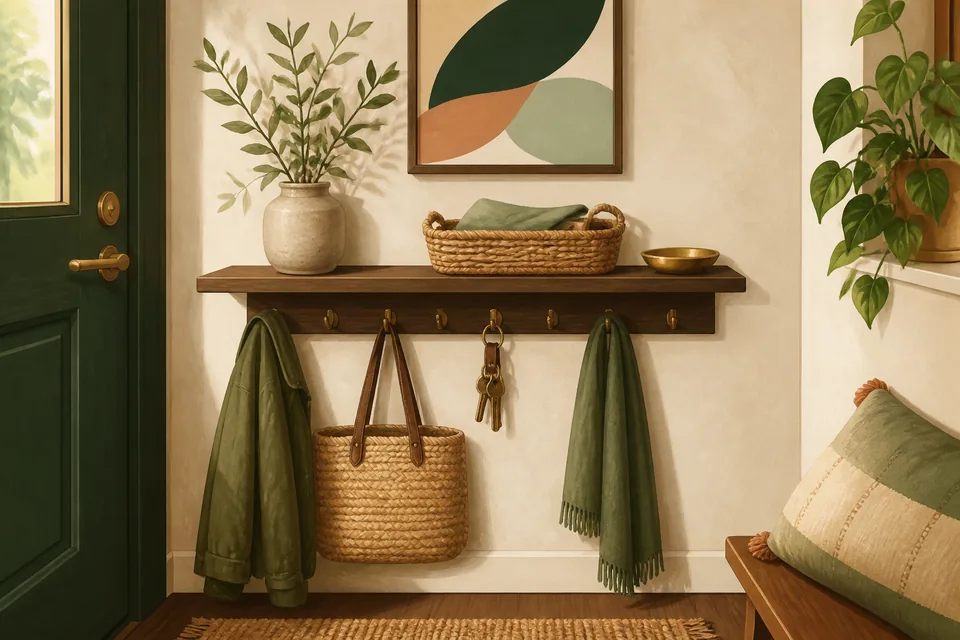
Most entryway advice assumes you have a mudroom's worth of space: built-in cubbies, a bench with under-seat storage, a full closet. If your entry is a two-foot strip of wall next to the front door, that advice is useless — and it's also not necessary. A genuinely small entryway needs three things, not ten, and all three can be wall-mounted, which means the floor stays clear no matter how tight the space is.
1. A landing zone for keys, mail, and pocket items
This is the piece people skip, and it's the one that prevents the most clutter. Without a dedicated small surface — even a shallow shelf 6 inches deep — keys end up on the kitchen counter, mail ends up on the floor, and both become permanent piles. A wall-mounted shelf directly at the entry, even a narrow one, gives everything a first stop before it migrates further into the house.
2. Vertical storage for coats and bags
Floor space is the scarcest resource in a small entryway, so anything that can move to the wall should. A row of hooks does more work per square inch than almost any other entryway fixture — five hooks under a shelf can hold what would otherwise require a closet's worth of hangers, and they cost a fraction as much as built-in storage.
Homode Wall Hooks with Shelf, Wood + 5 Metal Hooks, Rustic Brown/Black
A shelf-and-hooks combo covers landing-zone and vertical storage in one mounted piece — a practical starting point if you're only adding one thing to a tight entryway.
View product details on Amazon →Mounting height matters more than people expect
Hooks mounted too high get ignored — if reaching a hook takes more effort than dropping a coat on a chair, most households will take the chair. Standard coat-hook height is 60–66 inches from the floor for adults; if kids are using it too, add a second, lower row around 40–45 inches rather than compromising on one height that serves no one well.
3. Somewhere for shoes that isn't the floor by the door
This is the piece that has the biggest visual impact, because loose shoes are usually the single messiest element of an entryway — more than coats, more than mail. Even a narrow bench with a shelf underneath, or a slim cabinet, gets shoes off the floor and out of the direct sightline from the front door.
A note on style, not just function
A small entryway is also usually the first thing guests see, which makes material choice worth a little extra thought even in a purely functional space. A warm wood tone on hooks or a bench reads as intentional rather than utilitarian — it's a small cost difference over plain wire or plastic organizers, but it's the difference between "storage solution" and "this looks like it belongs here."
For the shoe-storage piece specifically — bench vs. rack vs. hidden cabinet — the right pick depends more on your household's habits than on square footage, which is its own decision worth walking through separately.