Choose the layout that fits your real arrival
Before buying anything, open the door fully and walk through as you normally would, carrying a bag or wearing a coat. Notice where shoes come off and what gets dropped first. Include the space anyone needs to move comfortably or use a mobility aid. There is no single clearance measurement that fits every door, household and home.
Try the arrangement with what you already own, but do not improvise a container or textile that leaks, moves underfoot or is unsuitable for your flooring.
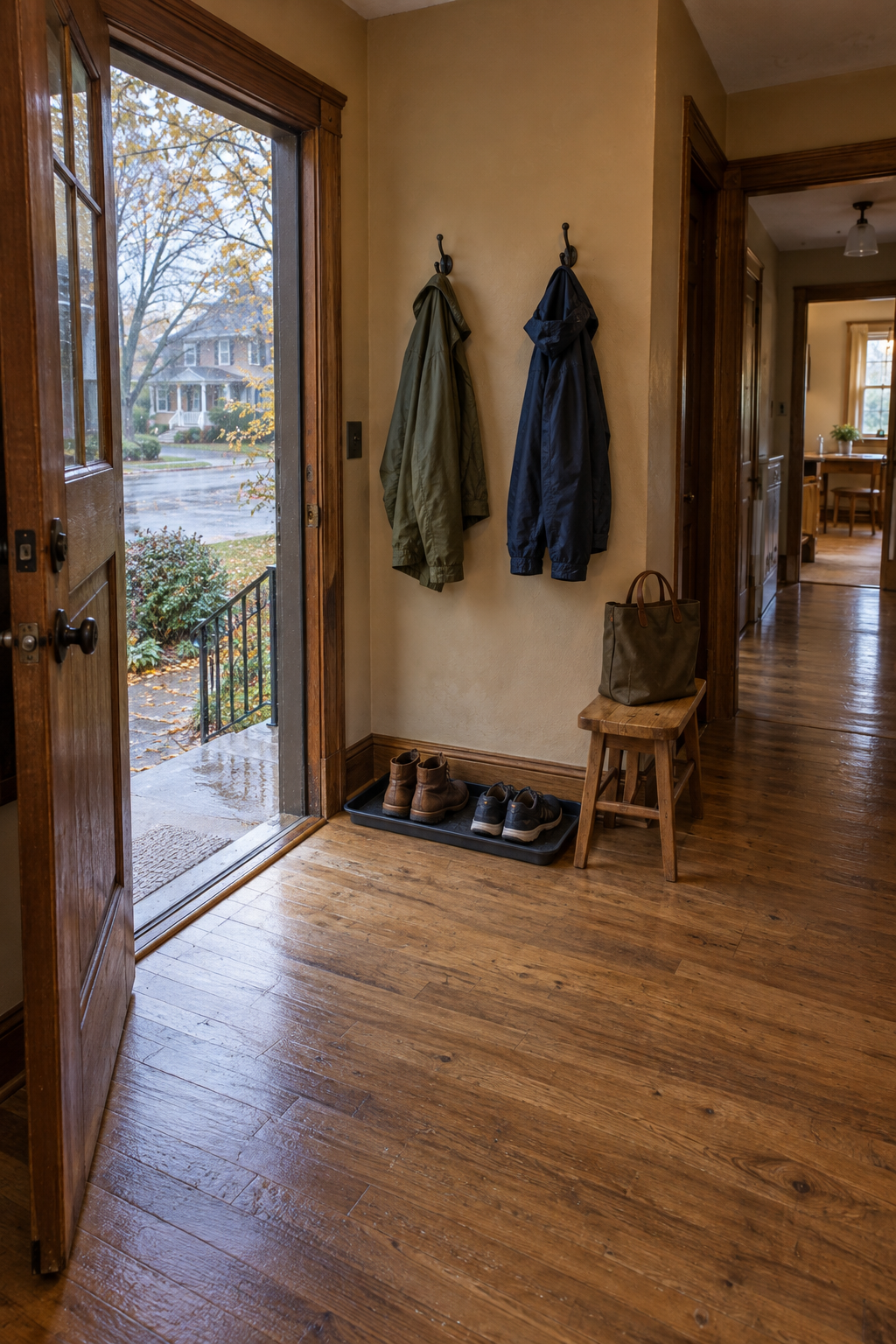
A narrow front entry: give the wall a job
In a hallway or entry that opens straight into the living room, a deep bench may take more space than it earns. Keep a compact wet-shoe landing place beside the route rather than across it. Put keys on a shallow surface, and reserve a nearby hanging spot for the coats currently in use.
Choose hooks and fixings for the wall and the intended load, following their installation instructions. Space hanging items so a damp coat is not pressed against another coat or tucked into a crowded cupboard. When it is ready for storage according to its care instructions, move it out of the arrival zone.
For dry keys, bags and everyday storage, the small-entryway guide covers the supporting pieces without turning this wet-weather setup into a furniture project.
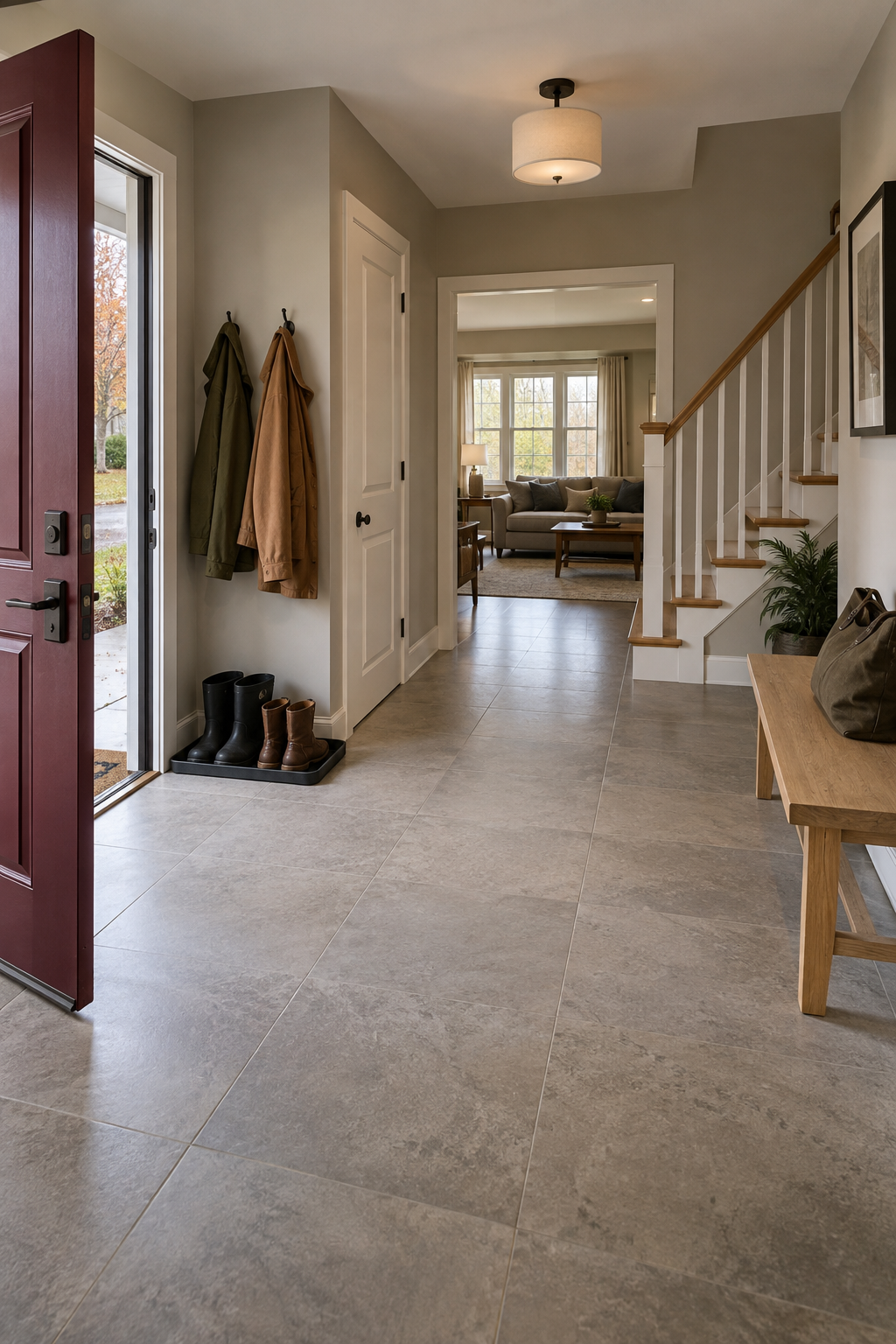
A roomy foyer: separate arrivals from stored belongings
More floor space makes it tempting to add more storage. Instead, give the first part of the room a clear purpose. Place the wet landing area near the arrival point, away from the route into adjoining rooms. Keep a console, dry-shoe storage or a seating area farther along the entry, where it does not become the default place for dripping items.
A seat is useful if someone needs it for changing shoes; do not add one solely to complete a styled vignette. Check that its position still works with the door open and someone seated. A patterned wall, painted console or colorful artwork can make this entry feel personal without filling the working floor area.
A back door or garage transition: follow the everyday habit
If everyone comes home through the kitchen-side door, a beautiful front-door arrangement will not catch the daily arrivals. Use the everyday entrance, even if its landing space is an unglamorous corner.
Give wet shoes a nearby temporary stop and keep dry bags, lunch containers and mail on a separate surface. If the area joins a kitchen, do not turn the food-preparation counter into the sorting station. Provide a distinct place for an umbrella if you use one; check that it can contain the drips and be emptied without leaving water behind.
The goal is a repeatable arrival, not a display of everything the household owns.
Give wet arrivals a beginning and an end
A wiping mat and a wet-shoe tray serve different jobs. A suitable mat is a place to wipe footwear. A suitable tray can be a temporary landing place for damp shoes. Check each item’s intended use and care instructions rather than assuming that “entryway” means it is compatible with your floor.
Keep the wet area separate from baskets of clean scarves, dry shoes and spare textiles. Follow footwear and garment care instructions for cleaning and drying; do not promise a fixed drying time. Let items finish their care process before putting them into closed dry storage.
Check the landing area after a wet arrival. Remove collected water and grit promptly, clean the tray according to its instructions, and check underneath it. A neatly arranged tray can still have moisture beneath it. Do not leave puddles on the floor simply because the shoes are contained.
Let your floor’s instructions lead
Flooring and finishes need different care. As one manufacturer-specific example, Mannington’s hardwood guidance recommends dirt-trapping mats at exterior doors and prompt spill removal with its recommended care methods. Those instructions are for Mannington hardwood, not a universal recipe for tile, vinyl, laminate or every wood finish.
Check your own flooring manufacturer’s guidance for suitable mat or tray contact materials, cleaning and drying. Do not assume a backing is non-staining, a surface is waterproof, or a product prevents slipping unless the relevant evidence supports it. Skip improvised cleaners and follow the instructions for the flooring actually in your home.
Make it cozy without filling the working space
Choose one or two fall touches that stay out of the arrival routine: an autumn-colored print, a warm wall color or a small arrangement on an established dry surface. A narrow entry can use olive and cream; a larger foyer might suit navy and ochre; a tiled back-door corner can feel welcoming with clay tones and simple wood details.
These are style possibilities, not rules for particular regions or budgets. You can use the colors already in your home. Keep floor-level decorations, trailing textiles and extra baskets out of the door swing and walking route. The best seasonal detail is one you do not have to move every time you come home.
Four different entryway jobs—not one shopping list
A wiping mat, a sole brush, a footwear dryer and an umbrella holder are not interchangeable. Each addresses a different part of coming home. Start with the recurring problem, compare the fit and upkeep, then choose the tools that earn their place.
Threshold wiping: compare door clearance, surface and care
A mat belongs where people can actually wipe their footwear without blocking the entrance. Measure the intended placement and test the door’s full swing. Appearance comes after floor compatibility, fit and a cleaning routine you can maintain.
Gorilla Grip WeatherMAX · Gray Diamond, 29 × 17 inches
The selected offer checked on October 13, 2026 lists a polypropylene face, natural-rubber backing and 0.3-inch thickness. Check the actual doorway and the floor maker’s backing guidance; a listed footprint is not proof of door clearance or surface compatibility.
Tradeoff and care: vacuum or shake off loose dirt, then spot-clean with mild detergent and a damp cloth and air-dry. Do not bleach. Place the mat flat, keep its underside dry and check below it: a wet backing may leave marks, residue or damage. The maker excludes concrete and certain finished-deck surfaces. No universal floor-protection or slip-prevention promise is made.
Use what you own: retain an existing compatible wiping mat when its placement and condition already meet the need.
Check current details on Amazon →Sole cleaning: distinguish a handheld brush from a doorway scraper
A brush lets you address individual soles and treads. That is a different routine from stepping onto a mounted scraper or wiping mat. Give it a footwear-only home and a suitable place to remove debris, away from the kitchen’s food-preparation area.
JobSite Sole Scrubber · model 54569
This handheld sole-and-tread tool has a wood handle and synthetic bristles. Consider it for recurring garden or yard debris when a hands-on cleaning step suits your household. It is not a fixed outdoor boot scraper.
Tradeoff: keep the sole/tread job distinct from treating delicate suede or sensitive uppers. Footwear care still governs. No exact storage-fit dimensions or washing, hose-cleaning or chemical-cleaner method is promised here; use the supplied instructions for the actual tool and footwear.
Use what you own: an existing dedicated footwear brush may serve the job where its intended use suits the footwear.
Check current details on Amazon →Damp-footwear care: allow space for the equipment and instructions
A dryer is an item-care tool, not a place to collect floor water. Check footwear care labels first, then the equipment’s electrical rating, clearances, ventilation and permitted uses. A storage cabinet is not automatically a suitable operating location.
PEET Original · Black, U.S. 120V
The selected offer checked on October 13, 2026 lists 36 watts and dimensions of 9.5 × 9.5 × 22 inches. This U.S. 120V version needs an appropriate operating location; it is not permission to heat every footwear material or a fixed drying-time guarantee.
Fit and instructions: the maker’s Original guidance calls for unobstructed base vents and proper DryPorts. Its requirement for at least six inches concerns the distance between the top of the footwear and the dryer base—not a generic all-around clearance. Boots over 11 inches need the specified extensions. The instructions supplied with the exact unit and the footwear’s own care guidance govern the setup and permitted use.
Warning and tradeoff: the exact Amazon listing carries a California Proposition 65 cancer and reproductive-harm warning. Review that warning and the supplied safety instructions before choosing the product. Required accessories, storage and electricity are additional considerations. No continuous-operation, all-material, garment/glove or health claim is made.
Use what you own: continue the footwear maker’s permitted unpowered drying routine when it meets the need.
Check current details on Amazon →Umbrella drips: compare shape, footprint and emptying
Choose around the umbrellas actually used: long, folding or both. Appearance alone does not establish water containment, capacity or stability. Consider how you will reach the water-catching component without spilling onto the floor.
SONGMICS Umbrella Stand · Black, ULUC026B33
The selected offer checked on October 13, 2026 lists steel and plastic materials, dimensions of 6.1 × 6.1 × 16.1 inches, a removable drip tray and four hooks. Check that its shape suits your umbrellas and that it stands outside the walking route while remaining easy to empty.
Tradeoff: this is still a water-catching item that needs attention. Empty collected water and check underneath as editorial precautions; these are not verified cleaner, anti-tip, rustproof, capacity or floor-protection claims. Follow the instructions supplied with the actual stand and your floor’s care guidance.
Use what you own: an existing dedicated water-catching container may do the job when its placement and contact materials suit the floor.
Check current details on Amazon →These descriptions use published product information and a dated exact-offer review, not hands-on testing. We have not tested cleaning, drying, stability or floor protection. Room illustrations do not depict these exact products. Availability, seller information and specifications can change; review the current listing and supplied instructions before buying. No retailer prices, ratings, reviews or product photographs are reproduced here.
Three household combinations—not one shopping list
- The daily walker with a narrow entrance: compare wiping and umbrella containment first. Test the door with the mat in position, then locate the holder outside the route. Neither needs to consume the space for bags or coats.
- The garden-to-kitchen household: a handheld sole-cleaning routine may address packed debris before threshold wiping. Decide where the dirty brush will live and how cleanup happens; keep that work separate from food preparation.
- The repeatedly damp-footwear household: compare an equipment-compatible care process after arrival. Confirm shoe materials, operating space and any required extensions before adding a dryer. Move ready-to-store footwear back to its dry home rather than making the equipment permanent storage.
Quick questions before choosing
Do I need all four? No. These are different options for different problems. Choose around the jobs that recur in your home, not a matching collection.
How should I compare costs? Include maintenance, storage, installation, required accessories and—where applicable—power requirements alongside the purchase price. Check current prices at the retailer rather than treating an old price as a promise.
Will one of these keep the whole entrance dry? No such claim is made. Item care, drip containment and floor care remain separate responsibilities. Keep the existing wet-to-dry reset even when adding a helper.
Keep the arrival zone temporary
When the setup fails, change the cause
If the door catches the mat, move or replace it rather than forcing the door. If a container leaks, stop using it and address the water according to the floor’s care guidance. If damp shoes accumulate, review their care process and return routine before adding capacity. Persistent blocked routes mean the arrangement needs fewer or differently placed pieces—not more accessories.
Once wet items are ready to put away, return them to their usual dry storage. Empty yesterday’s bag, move mail to its real destination, and leave space for the next arrival. If the tray is continually full, reduce what lives there before buying a larger one.
For longer-term dry shoe storage, the bench, rack and cabinet comparison can help you choose a format. That is a separate decision from handling wet arrivals.
You are finished when the route is clear, the wet landing area has been checked and the next person can use it without rearranging the whole entry. A comfortable welcome can still look like an ordinary home.
Image note: the room images are original AI-generated editorial illustrations, not photographs of real installations, exact retailer products or tested arrangements.