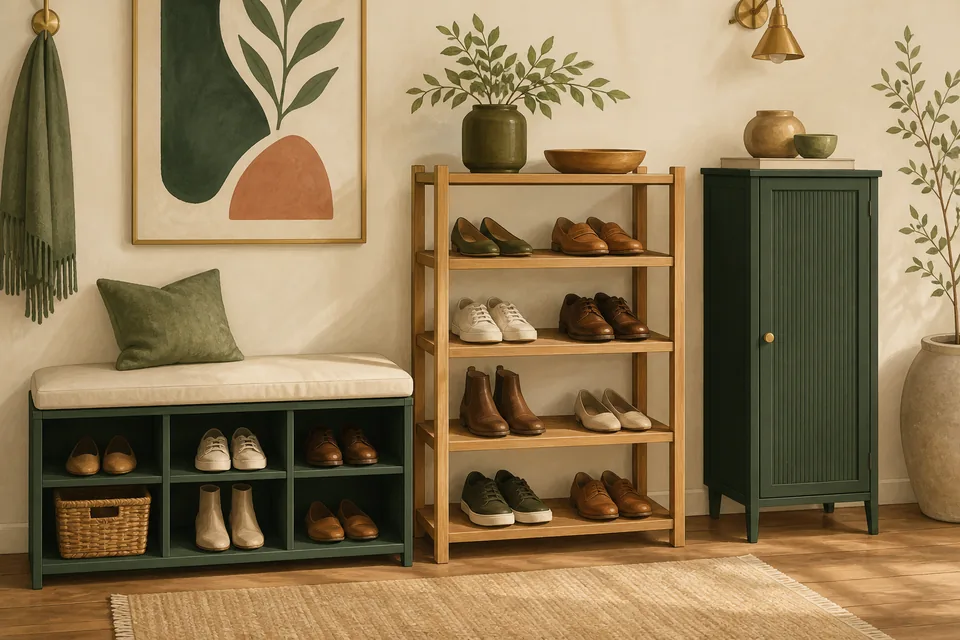
Shoe storage advice usually starts and ends with "get a rack," but the format that actually gets used long-term depends less on space and more on behavior: does your household take shoes off standing up or sitting down? Do shoes need to be visible to get put away, or hidden to look tidy? Getting this wrong is why so many shoe racks end up as a shoe pile next to an empty rack.
The open rack
A simple tiered rack is the cheapest and most space-efficient option per pair of shoes, and it works well for households that actually will place shoes on shelves consistently. The failure mode is specific: if there's any friction at all — a rack that's a reach away, or angled awkwardly — shoes end up on the floor beside it instead of on it. Open racks work best for single-person or two-person households with consistent habits, not usually for kids.
The bench with storage
A bench solves a different problem: it gives you somewhere to sit while putting shoes on or taking them off, which removes the "I'll just leave them by the door" temptation that standing-only storage doesn't address. Benches with a shelf underneath or a lift-up seat combine seating with storage in the same footprint a bench alone would take.
PETKABOO Shoe Bench with Hidden Drawer, 2-Tier, Bamboo
Seating plus a hidden drawer — a good match for households where "sit down to take shoes off" is the realistic habit, not "place them neatly on a rack."
View product details on Amazon →ZOPEND 50" Entryway Shoe Bench with Hidden Storage
A longer bench for entryways with more than one or two people taking shoes off at the same time — the extra length matters more than it seems until you're waiting for the bench to free up.
View product details on Amazon →The hidden cabinet
Cabinets trade convenience for appearance — shoes go behind a door, which means the entryway looks tidy even when the shoe collection inside isn't. The real cost is friction: a door that has to be opened and closed for every pair is enough extra effort that, in busier households, shoes start accumulating in front of the cabinet instead of inside it. Cabinets work best for households with fewer, more deliberate shoe-storage habits, or for shoes that are worn less often — the ones you don't need daily access to.
How to actually decide
- If people sit down to remove shoes: a bench, every time — fighting that habit with an open rack rarely works.
- If the entryway needs to look guest-ready most of the time: a cabinet, accepting the slightly higher friction as the tradeoff for a cleaner look.
- If space and budget are the main constraints: an open rack, understanding it works best for consistent, low-clutter households.
Pair whichever you choose with the wall-mounted storage covered in Small Entryway, Big Function — shoes and coats are almost always the two biggest sources of entryway clutter, and solving only one leaves the other half of the problem in place.