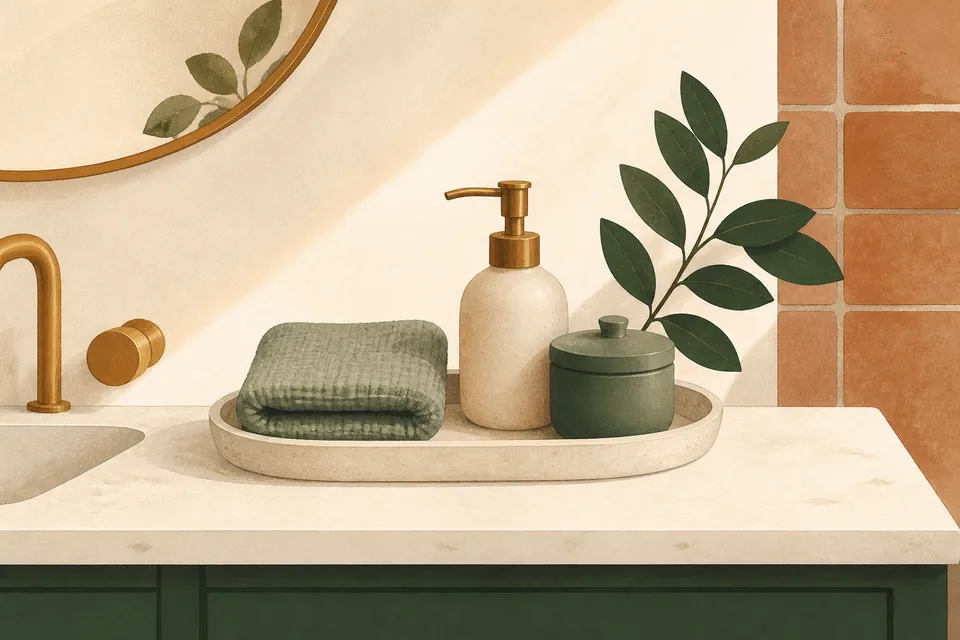
Bathroom counters accumulate clutter faster than almost any other surface in the house, mostly because everything on them is used daily, which means there's never an obvious moment to put things away. The fix isn't more storage capacity — most bathroom counters already have enough space. It's containment: giving everything a defined zone so "daily use" doesn't mean "permanently scattered."
Why a tray works better than a drawer
Drawers hide clutter, which sounds like a win until you actually need something and the drawer becomes its own chaos. A tray does the opposite: it contains items within a visible boundary, which does two things a drawer can't — it makes the counter around the tray easier to wipe down (everything's corralled in one spot), and it creates a soft social pressure to keep the tray itself tidy, since it's not hidden.
Homode Bamboo Bathroom Vanity Organizer Tray with Drawers
A tray with small drawers underneath — visible surface for daily items, contained storage just beneath it for the smaller things that don't need to be on display.
View product details on Amazon →The fifteen-minute version
- Clear the whole counter — everything, even things you're putting straight back. Two minutes.
- Sort into three piles: daily-use (goes back on the counter), occasional-use (goes in a drawer or cabinet), and expired or empty (goes in the trash). This is the step people skip, and it's the one that actually reduces clutter rather than just rearranging it.
- Wipe the counter down while it's empty — this almost never happens otherwise, since there's always something in the way.
- Place the tray first, then add only daily-use items to it. If something doesn't fit on the tray, that's useful information: it's probably occasional-use, not daily-use, and belongs in the drawer pile instead.
What actually belongs on the tray
A useful test: if you touch it every day, it goes on the tray. If you touch it a few times a week, it goes in a drawer within reach. If you touch it monthly or less, it doesn't need counter-adjacent storage at all — a cabinet or even a different room is fine. Most bathroom clutter comes from occasional-use items being stored at daily-use convenience, "just in case," which is worth resisting.
Keeping it reset
The fifteen-minute version above works as a one-time fix, but the tray boundary is what keeps it reset without repeating the whole process weekly. Once the boundary exists, maintenance becomes a ten-second habit — anything that doesn't fit on the tray doesn't get added to the counter, full stop — rather than a recurring cleaning project.