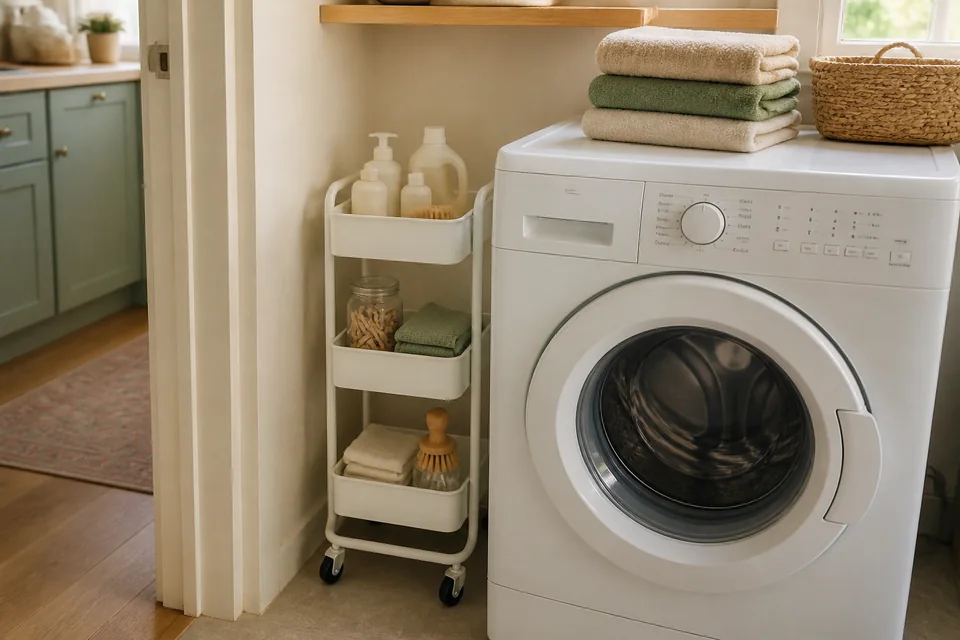
A small laundry room can feel crowded even when it holds very little. The problem is usually not the number of supplies. It is that every bottle, brush, cloth, and stray sock is competing for the same two landing places: the top of the washer and the floor.
That creates a particular kind of household friction. You move detergent to open the machine. You move the basket to reach the shelf. A clean load waits on top of the dryer because there is nowhere else for it to pause. By the middle of the week, the room is technically functional but emotionally tiring.
The way out is not a wall of new cabinetry. It is a narrower system: give each part of the laundry process one small home, leave the work surfaces open, and stop storing unrelated things in the room simply because there is a shelf.
Begin with the path laundry actually takes
Before buying an organizer, watch one load move through the room. Where does the hamper stop? Where do you set the detergent? Where do clean clothes wait before they are folded? Those three moments matter more than a perfectly matched set of containers.
A practical laundry space needs a clear path from dirty to washing to clean. When those stages overlap, clutter forms. If dirty clothes sit in front of the washer, the hamper needs a different parking place. If clean clothes live on the dryer for days, folding needs to happen somewhere more comfortable than the laundry room.
Give each level one job
A slim rolling cart earns its footprint when its levels follow the order of use. Keep the things you touch every load at a comfortable height, occasional treatments below them, and lightweight extras at the bottom.
- Top level: everyday detergent and a small stain tool.
- Middle level: mesh bags, dryer balls, clothespins, or specialty products used less often.
- Bottom level: folded cleaning cloths, a small trash-bag roll, or an empty spot for stray items that need to leave the room.
The empty spot is intentional. Storage systems fail when they are filled to the edge on day one. Laundry produces temporary objects — a missing sock, a pocket receipt, something that needs mending — and those items need a brief landing place that is not the washer lid.
Simple Houseware 3-Tier Slim Rolling Cart with Handle, 5.5-Inch Wide, White
The narrow width is the useful part here: it can turn an otherwise awkward gap into accessible storage while keeping the appliance tops free. Measure the full opening, including hoses, trim, and room for the wheels to move, before ordering.
Check current details on Amazon →Measure the gap you actually have
A listed cart width is not the same as the clearance it needs. Baseboards can narrow a gap near the floor, dryer vents can occupy space behind it, and a cart that technically fits may still be impossible to pull forward. Measure at the floor, middle, and top. Then leave a little breathing room rather than treating the measurement as a perfect target.
Also decide which direction the cart will roll. A handle facing the wall is decoration; a handle you can reach from the doorway is useful. The best position is not always centered between the machines. It is wherever the cart can come out without requiring the hamper, door, or your body to move first.
Decanting is optional
Matching containers can make a shelf look quieter, but they are not required for the system to work. Keeping products in their original containers preserves their directions and safety information. If you do transfer a non-hazardous item, label it clearly and retain the original instructions. Never mix cleaning products, and keep laundry supplies where children and pets cannot reach them.
A visually calm room can come from repetition instead: place tall bottles together, fold cloths to one width, and choose one small bin for loose accessories. Order creates most of the effect. New packaging is not the essential ingredient.
Let the room finish empty
The most helpful end-of-load habit is not another cleaning task. It is returning the room to a ready state: close the product, put the tool back, wipe one obvious drip, and roll the cart home. That takes less than a minute, but it means the next load begins without negotiating with yesterday's clutter.
If you want to extend the same idea into another hardworking space, the boundary principle in the bathroom-counter guide works here too: one defined home for daily essentials, with everything else stored away from the work surface.
A small laundry room may never feel spacious. It can still feel settled. The real win is walking in with an armful of clothes and having a clear place to stand, a clear surface to use, and nothing you need to move before you can begin.