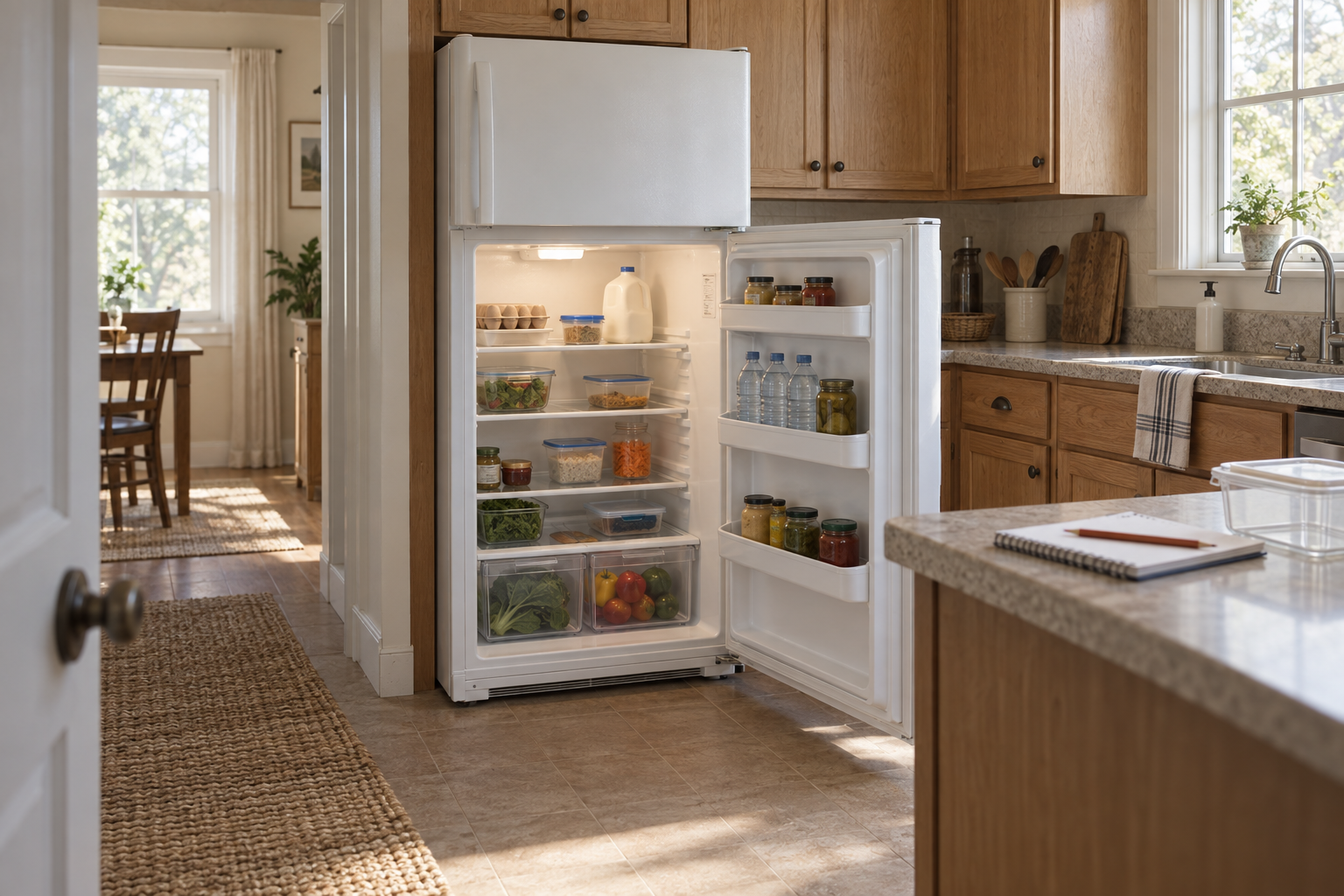
An organized fridge does not have to look like a row of matching containers. It needs to work when the groceries come home, when someone reaches for an ingredient, and when another person puts things away.
Perhaps a tall package hides what is behind it. Perhaps one bin must come out before anything else can move. Or perhaps the arrangement makes sense only to the person who created it.
Start with that recurring snag. You can test a more useful arrangement without replacing your containers or giving the whole fridge a makeover.
Image note: The kitchen is an original AI-generated concept, not a real-home photograph, tested setup, exact product image, or food-placement guide. The shelf sketch is an original question prompt.
Put food and appliance instructions first
Convenient grouping comes after appropriate storage. The FDA recommends keeping the refrigerator at 40°F (4°C) or below, checking with an appliance thermometer, allowing air to circulate, and following food-label instructions. Perishables should not sit at room temperature for more than two hours, or one hour when the temperature is above 90°F. These are limits, not a target working time.
Work on a small section and return refrigerated items promptly; do not empty the whole fridge onto the counter. Keep the door closed between checks.
The USDA’s refrigeration guidance says to keep perishables out of the door, eggs in their carton on a shelf, and raw meat, poultry, and seafood securely contained to prevent leaking. Appearance alone cannot establish food safety. Use the linked guidance and its food-storage chart for item-specific limits.
Check your appliance manual before moving shelves, obstructing openings, or choosing containers. Those requirements take priority over every organizing idea below.
Find the problem before changing the shelves
Notice what happens during an ordinary fridge visit. What do you move twice? What disappears behind something else? Where does an item get left because its usual place is difficult to reach?
Choose one problem. “The fridge is a mess” is hard to act on; “I cannot reach this container without lifting another one” gives you something specific to test.
Use this decision aid within the storage conditions appropriate for each food.
| The snag | What to observe | One reversible test |
|---|---|---|
| Something disappears | Which taller package hides it? | Within its appropriate storage area, try a different front-to-back arrangement. |
| Reaching disrupts other items | What must move before you can lift it out? | Remove an unnecessary outer organizer or test a less obstructed position. |
| A container is awkward | Can you grip it, lift its lid, and pull it out? | Compare access without that container before buying a replacement. |
| Things never go back | Where would another user put them, and why? | Simplify the arrangement or add a short shared note. |
Change one thing, then try the same everyday action again. If it adds another step or creates a new obstruction, put it back and choose a different test.
Sketch your fridge, not an ideal one
A top-freezer refrigerator, a narrow side-by-side model, and a French-door appliance do not offer the same usable space. Even similar-looking models can have different shelf adjustments, vents, and drawer-clearance requirements.
The empty-shelf diagram is a prompt for questions, not a food-placement map. On a quick sketch of your own fridge, mark three things:
- What you can see from your normal standing or seated position.
- The path your hand and a container need when reaching in and pulling out.
- The openings and door or drawer movements that must remain unobstructed.
Take any measurements during brief checks, then close the door while you plan. Do not assume the entire shelf’s width and depth are available for an organizer. A container can fit on the glass and still prevent a drawer from opening or a hand from getting underneath it.
Before buying a fridge bin, answer these questions
A bin is useful only if it resolves a specific problem without creating another.
- What would it do? Name the items or repeated action it would support.
- Can something already owned do that job? Include using no extra container as an option.
- Does it fit in use? Check the actual space, grip, lid movement, door swing, and appliance restrictions—not just the advertised dimensions.
- Does it preserve visibility? Will its sides or the items inside hide what you need to identify?
- Is it suitable for its intended use? Follow the container maker’s food-contact and care instructions; keep necessary food labels and storage directions accessible.
- What happens when the grocery load changes? Consider the ordinary package that is taller or wider than the rest.
If those answers are unclear, keep the current setup while you observe the problem again. You do not need to buy a full set to test one change.
Make the arrangement a shared household plan
A fridge system should not depend on one person silently correcting everyone else. Walk through the proposed arrangement with the people who use it, including anyone who needs a different reach height or grip.
Keep food-storage requirements fixed, then discuss the practical choices that remain. A short note beside the shopping list might say:
Return items to the agreed place. If it is full, flag the problem before rearranging another area. Add the recurring snag to this list.
That note explains a household routine. It does not replace package dates, storage instructions, or food-safety guidance. If the plan needs a long explanation, see whether you can remove an unnecessary label, an extra organizer, or an unnecessary step.
Separate an organizing change from appliance cleaning
If you notice a shelf needs cleaning, pause and consult the model’s care instructions. GE’s shelf-care guidance cautions against exposing cold glass to hot water; do not assume removable shelves are dishwasher-safe. Follow the instructions for your particular appliance rather than a generic cleaning recipe.
Check the same snag next time
When you next put groceries away, revisit the problem you chose. Can you see the item? Can you retrieve it without disrupting the surrounding area? Does another household member understand where it returns?
Keep the change if it helps those actions. Revise it if it only looks tidier.
The goal is an arrangement that fits your appliance, your groceries, and the people using them—with appropriate storage as the starting point. Matching containers are optional. A clear reason for each change is more useful.
For more practical routines around your home, browse our organizing guides or home-care guides.
Food-storage and appliance references reviewed September 23, 2026. This is an organization guide, not recall, contamination, power-outage, or appliance-repair guidance.