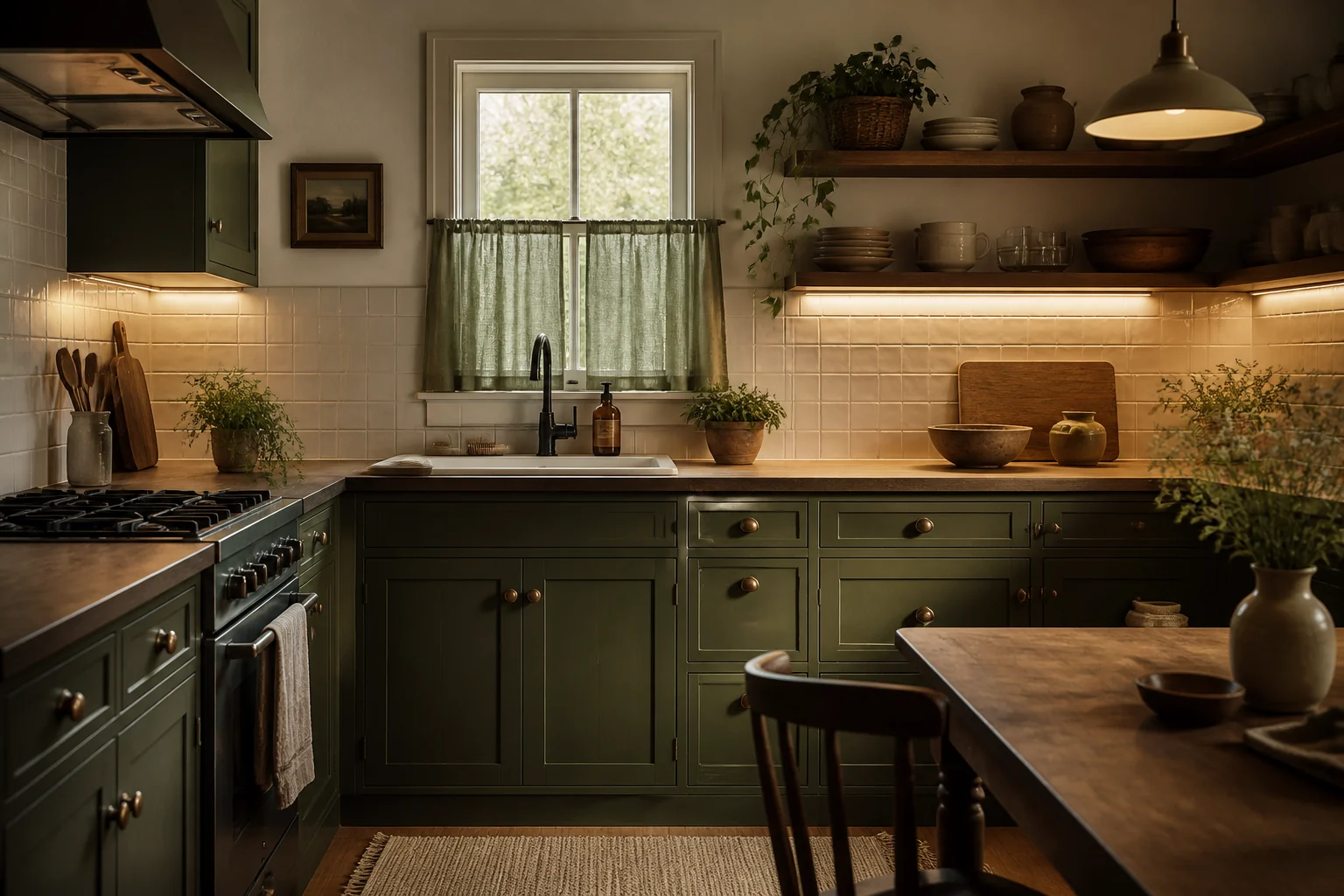
Dark cottagecore kitchens are appealing for a reason. Deep olive paint, aged wood, old brass, linen, and pottery can make an ordinary room feel rooted and collected. The trouble begins when every surface absorbs light and the room stops working comfortably.
You do not have to repaint the cabinets or turn the kitchen white. The goal is to give the darkness something warm to rest against: focused task light, a little cream, one repeated metal, natural wood, and enough open space for the eye to settle.
Start with the room at the time you use it most. A kitchen that looks lovely at noon may feel heavy at 7 p.m. The most useful changes solve that evening version without erasing the mood you liked in the first place.
1. Let one dark color anchor the room
Choose the deepest surface that already defines the kitchen—usually cabinets, a painted wall, or a large piece of furniture—and let it be the anchor. Do not try to match every accessory to it. Repeating the same dark green or brown in curtains, rugs, dishes, and art can flatten the room into one visual block.
Instead, surround the anchor with quieter contrast. Cream tile, warm white walls, natural wood, and soft sage all let deep olive feel intentional. If the cabinets are already dark, keep the countertop work zone visually lighter and avoid adding another dark backsplash simply because it looks dramatic in a sample.
Use-what-you-have option: remove the darkest small objects from the counter for a week. Often the cabinets are not the problem; the black appliance cluster, dark canisters, and crowded corners are what push the room from moody to dim.
2. Add warm task lighting where work happens
A ceiling fixture can make a room technically bright while your body still casts a shadow across the cutting board. Under-cabinet light is useful because it puts light on the task instead of asking one overhead bulb to do everything.
Look for warm white light around 2700K, dimming, and an installation method that suits the cabinet. Before buying, map the outlet, cord route, switch position, and the full length of the work surface. A neat line of light helps; a dangling cord across a prep area creates a new problem.
ASOKO Dimmable LED Under-Cabinet Lights, 2700K, Three 12-Inch Bars
The three linkable warm-white bars put focused light across a longer counter and offer stepless dimming with a memory function. Magnetic, adhesive, and screw-mounting hardware are listed with the set.
Check before buying: this plug-in set needs a nearby outlet, and the cord may remain visible. Measure the cabinet run, plan the cord path, and make sure the mounting surface is clean and appropriate before using adhesive.
Check current details on Amazon →Lower-cost alternative: try a lamp you already own on a safe, dry surface, or replace a harsh cool bulb in an existing fixture with a warmer compatible bulb. Keep portable lamps and cords away from sinks, heat, and wet work areas.
3. Preserve window light with café curtains
A dark kitchen benefits from every useful inch of daylight. Full-length, lined, or blackout panels can solve privacy while taking away the light the room needs. A café curtain covers the lower portion of a window, softens the glass, and leaves the upper half open.
Sage linen or a small gingham can connect dark green cabinets to cream walls without becoming another heavy block. Measure the actual glass and decide how much privacy you need before choosing a length. Light-filtering fabric offers daytime softness; it is not the same as full nighttime privacy.
Reuse-what-you-have option: clip a clean cotton tea towel to a small tension rod for a few days. It is an inexpensive way to test height, fullness, and privacy before buying a curtain made for the window.
4. Repeat one warm metal finish
Aged brass brings a small, warm highlight to matte green or brown cabinets. It works best as a repeated punctuation mark—knobs, a faucet detail, or one light fixture—rather than a mix of shiny gold, black, chrome, and copper competing at once.
Changing hardware is one of the few updates that can alter the room’s rhythm without changing its large surfaces. Count every door and drawer, confirm whether each piece uses one hole or two, and measure the existing hardware before ordering. Keep the old screws and pulls together so the change remains reversible.
HUGOLEM Antique-Brass Round Cabinet Knobs, 10-Pack
This single-hole set uses a simple round shape and an antique-brass tone that can warm dark painted doors without turning the kitchen into a themed set. The listing includes several lengths of break-away mounting screws.
Check before buying: ten knobs may not cover a larger kitchen, and a single-hole knob will not directly replace a two-hole pull. Compare the screw diameter, door thickness, count, and finish with what is already installed.
Check current details on Amazon →Lower-cost alternative: remove and clean the existing hardware, then reinstall it evenly. If the finish still works, correcting crooked knobs and sticky buildup can make the cabinet fronts feel calmer for almost no cost.
5. Build contrast with cream and natural wood
Cream keeps a dark room warm in a way that bright white sometimes does not. Use it where you already need something: a washable towel, a bowl, a small lamp shade, or the everyday dishes on an open shelf. Natural wood does the same job with texture.
One medium wood tone is enough. A cutting board leaned against the backsplash, a stool, or an existing shelf can echo the warmth of the floor. Avoid adding several orange, gray, and red stains just to fill empty space. The room will feel more collected when the wood tones speak to one another.
6. Keep the counters visually quiet
Dark cabinets already carry visual weight. A crowded counter adds a second dark horizon that makes the work surface feel smaller than it is. Keep out only what supports a routine you actually perform there.
- Group the coffee pieces into one working zone instead of scattering them across the kitchen.
- Store backup oils, spices, and paper goods behind a door.
- Leave at least one clear landing area beside the sink or stove.
- Use a tray only when it makes several daily items easier to lift and wipe beneath.
The small farmhouse coffee-bar guide shows how to keep one warm corner useful without letting it spread across the counter.
7. Know when moody has crossed into gloomy
A room has crossed the line when the atmosphere interferes with ordinary tasks. If you cannot read a label, judge whether the counter is clean, see inside a drawer, or prepare food without moving toward the window, the room needs better light—not more décor.
Also watch for emotional heaviness. Deep color should make the room feel held, not closed in. If the kitchen feels smaller every time another object arrives, remove something before adding a lighter accessory. Contrast and empty space are often more effective than a purchase.
A one-hour cozy-not-gloomy plan
- Photograph the kitchen in daylight and again after sunset.
- Clear the counters and return only the pieces used every day.
- Choose the one dark color that will remain the anchor.
- Test warmer task light on the darkest work surface.
- Open the upper portion of the window and reassess privacy.
- Repeat one warm metal and one wood tone already in the room.
- Stop before the room becomes a shopping list.
Current kitchen research supports this practical balance: the NKBA 2026 Kitchen Trends Report emphasizes natural, task, and under-cabinet lighting, while Sherwin-Williams’ designer outlook points toward natural wood, authentic materials, and warmer moody neutrals.
Product note: Product details, seller information, and availability can change. Confirm the current listing, measurements, electrical requirements, and mounting instructions before buying. The café-curtain guidance is intentionally noncommercial because the shortlisted product did not meet our recommendation standard.