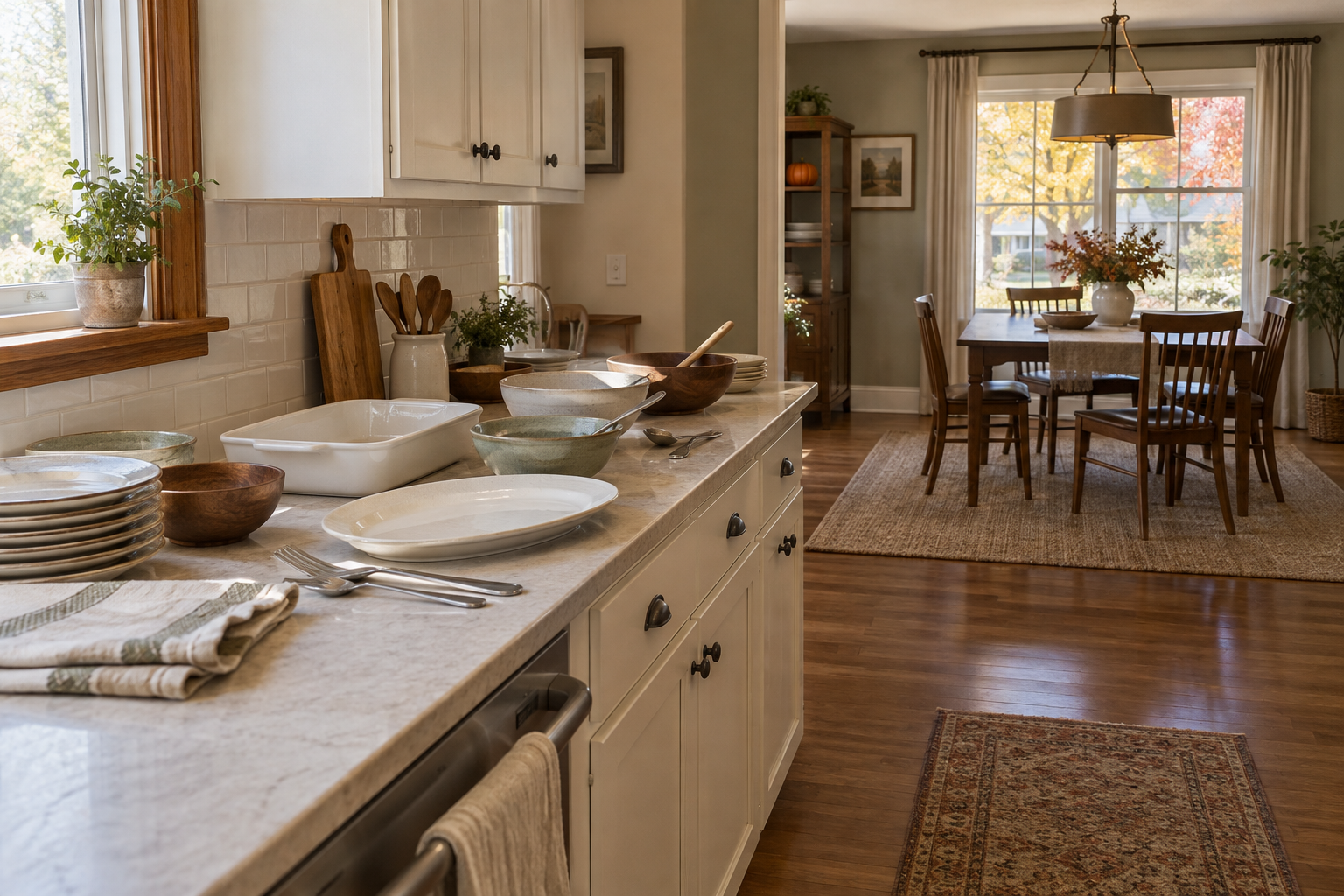
The turkey platter fits on the table—until the potatoes arrive. Someone needs a glass, the gravy has nowhere to land, and a pulled-out chair blocks the route back to the kitchen. The problem is not a shortage of decorations. It is that the meal needs more usable space than the empty room suggested.
A useful Thanksgiving buffet setup begins with the dishes you will actually serve. Choose whether people will collect a plate, pass food while seated, or do a little of both. Then test that plan before buying another tray or arranging a centerpiece. This works for a few people around a kitchen table as well as a larger gathering across adjoining rooms.
Choose the way your household can serve comfortably
Buffet: collect a plate, then sit
Try this when a suitable counter or sideboard can hold serving dishes and guests can reach it without queuing through the cooking area. It frees table space, but carrying a plate is not comfortable for everyone. Offer help or serve someone at their seat when preferred.
Family-style: pass dishes at the table
Try this when the table holds the place settings and serving dishes without crowded elbows or awkward reaches. Heavy, hot dishes are not good candidates for a long pass. Smaller portions or help from the host can be more manageable than one enormous platter.
Hybrid: give each surface one job
Serve the main food from a suitable counter, with a small bowl of rolls or another easy-to-pass item at the table. Keep the arrangement simple: guests should not have to tour several rooms to complete a plate.
Ask about practical needs rather than assuming everyone can stand in line, carry a full plate, or reach the same height. A seat-side serving option can be part of any layout. If a buffet creates a difficult route, family-style or host-served plates may be the better choice.
Choose a surface for the real dishes, not a photograph
Set out the empty platter, bowls, sauce jug, utensils, and any heat protection the surfaces require. Include handles and lids. A dish that fits only when its handle sticks into the walkway does not fit the job.
An existing kitchen counter
Useful when it is clear of active preparation and safe to approach. Check the oven, dishwasher, refrigerator, drawers, and sink access. Do not turn the working stove into a guest buffet or ask someone to reach across hot equipment.
A dining-room sideboard
Useful when its usable depth, stability, and surface care suit the dishes. Check doors and drawers with the room occupied. Keep serving within comfortable reach instead of filling a deep back row that requires leaning over food.
The dining or kitchen table
Useful when there is no separate serving surface. Test it with every planned place setting and chair in use. Serve part of the meal from the kitchen if all the bowls will not fit. A smaller menu or a second serving round is an option; new furniture is not a requirement.
Use only stable furniture intended to support the load, and follow its surface-care instructions. An ironing board, stacked boxes, or a decorative shelf is not a substitute for a suitable serving surface. There is no single clearance measurement that makes every home, chair, or mobility aid work: test the actual route with the people who will use it.
Arrange the first plate—and the trip back for seconds
For a one-direction buffet, a useful starting order is plates, main dishes, sides, then the sauces that belong with them. Put a serving utensil with each dish and provide a sensible resting place for it. Leave a clear place to set a plate briefly rather than making every guest balance it while lifting a lid.
Keep napkins and cutlery at the table, or at the end of the buffet, so people have fewer things to carry while serving. The order is a starting point, not a rule: move the sauce beside the food it accompanies if that avoids reaching back across someone else.
Choose a return route for seconds that does not send a full plate back against the line. In a narrow room, invite people in small groups or serve at the table instead. Keep the route to an exit usable; do not solve a serving problem by blocking a doorway.
Separate drinks only if the second spot really works. A stable, accessible counter away from hot food can reduce a bottleneck. Check spill cleanup, glass reach, and the route from seats. If the only spare spot blocks a hall or is difficult to reach, keep water at the table and offer refills instead of creating a drinks station for its own sake.
Do an empty-dish dry run before the holiday
- Place the dishes. Label each empty bowl or platter with the food it will hold. Include utensils, trivets if required, and lids that need somewhere to go.
- Set every seat. Pull chairs out as people will use them. Include any high chair or mobility aid relevant to the gathering, without treating it as decoration or spare storage.
- Walk the first plate. Carry an empty plate through the proposed sequence. Notice where you need a free hand, a long reach, or a place to set something down.
- Try the return trip. Have another person sit or stand in the busiest spot. Test seconds, water refills, access to the refrigerator, and the way dishes will return to the kitchen.
- Remove one obstacle. Move a dish, reduce what sits on the table, or change serving style. Test again before deciding a new product is necessary.
Only then add the seasonal layer. A small arrangement where it does not interfere with food or sightlines is enough. Keep decorative objects out of food and away from heat. Our simple fall-table guide covers the color and texture choices; this guide is about making the meal fit.
A serving helper for a specific gap
The article does not need an extra item to work. Start with an owned jug, bowl, or small plate; consider an addition only when the dry run identifies a recurring problem.
OXO Good Grips Non-Slip Spoon Rest · single stainless-steel version
The exact offer checked on October 10, 2026 lists a 6 × 4.5-inch stainless-steel rest with a silicone base or feet, listed as dishwasher-safe. It gives one utensil a landing place; it does not replace a serving tool for each dish. Allow for the utensil handle as well as the rest's footprint.
Fit and tradeoff: it occupies counter space and still needs cleaning. Do not place it on a burner or treat it as a hot-pan trivet. A small owned plate is a useful first test. Follow the supplied care instructions and check that the rest fits your intended utensil.
Check current details on Amazon →This description uses published product information and a dated offer inspection, not hands-on testing. We have not tested its stability, surface protection, or cleaning performance. Generated room imagery is not proof of the exact product.
Plan food timing separately from the furniture
A neatly arranged buffet does not keep food at a safe temperature. The FDA's safe-buffet guidance calls for hot food to stay at 140°F or warmer and cold perishable food at 40°F or colder. Use a food thermometer and equipment suited to the job; a decorative dish is not a warmer.
Refrigerate perishables promptly. Unless kept safely hot or cold, discard perishables left at room temperature for more than two hours; the limit is one hour where the temperature is above 90°F. These are limits, not a target display time. Use small serving portions and replace nearly empty dishes with fresh ones rather than topping them up. Divide leftovers among shallow containers for quicker cooling in the refrigerator, and check the FDA guidance for the food you are serving.
Before guests arrive, make refrigerator space and choose where used dishes will land without contaminating the serving area or blocking the sink. See our practical fridge-organization guide for storage planning. Clear and store food first; reset the decorative pieces afterward.
What if there is no room for a buffet?
Use the table for seated family-style service, have the host serve plates from the kitchen, or combine the two. Keep only the dishes needed for that round within reach. A comfortable meal is the goal—not proving that every home can support the same sideboard display.
Where to start this week
Take out the largest serving dish, put it on the proposed surface, and set the nearest seat. That small test is more useful than ordering a matching hosting set. Once the route works, keep the seasonal styling simple and let the food—and the people—be the center of the room.